
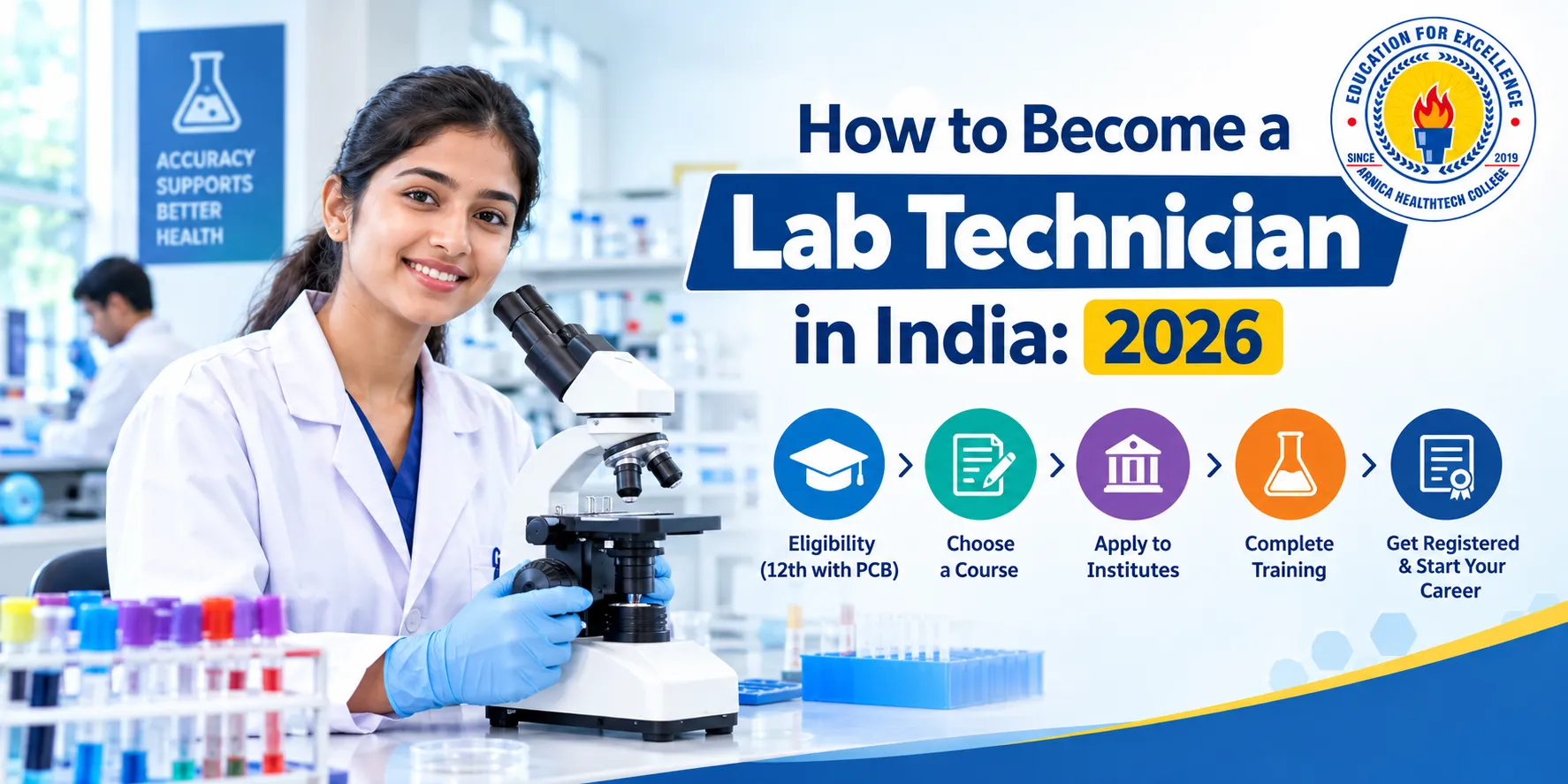
Quick answer: To become a lab technician in India, pass Class 12 with Physics, Chemistry and Biology, then complete a two-year DMLT or a degree such as B.Voc or B.MLS in medical laboratory technology at a recognized institute. Finish the practical training and internship, register with your state allied and healthcare council once registration opens, and apply to hospitals or diagnostic labs. The full path takes two to four years.
On September 15, 2026, the National Commission for Allied and Healthcare Professions (NCAHP) gazetted rules that will require lab technologists to register in state and central registers, much like doctors and nurses. For a student working out how to become a lab technician, that changes the plan. The course you choose, and the institute that teaches it, now decide whether your qualification counts when registration opens.
This guide is written for students finishing Class 10 or Class 12 who want a stable healthcare career without spending years on MBBS. It covers the exact steps, eligibility, the difference between DMLT, B.Voc and B.MLS, the NEET question, registration, salary and job paths. Every figure was checked against sources in October 2026, and where sources disagree, we say so.
What Does a Lab Technician Do?
A lab technician is an allied health professional who collects, prepares and tests blood, urine, tissue and other samples so doctors can diagnose disease. Most of the work falls into haematology, clinical biochemistry, microbiology, histopathology, serology and blood banking. When a doctor orders a blood sugar, dengue or thyroid test, a lab technician runs it and reports the result.
Technician and technologist are not the same role. Technicians usually run routine tests under supervision, while technologists, who typically hold a degree, handle complex analysis, quality control and lab management. Our explainer on what a medical laboratory technologist does covers that difference in detail.
One naming change is worth knowing. NCAHP has recommended replacing the word "paramedical" with "allied and healthcare", and lab professionals now sit in the "Medical Laboratory and Life Sciences" category. If you are new to the field, start with what a paramedical course is to see where lab technology fits.
How to Become a Lab Technician in 7 Steps
The route is the same for most students: qualify in science, pick a course level, study at a recognized institute, train on real samples, complete an internship, register and get hired. Here is each step in order.
Step 1: Pass Class 12 with science
Most diploma and degree programs ask for 10+2 with Physics, Chemistry and Biology (PCB) from a recognized board. The NCAHP competency-based DMLT curriculum, notified on July 1, 2026, describes the diploma as a two-year program for students who passed Class 12 in the science stream with these three subjects. If you are still in school, choosing PCB in Class 11 keeps every option open. You can read the course-level breakdown on our DMLT course after 12th and MLT course details after 12th pages.
Step 2: Choose between a diploma and a degree
A diploma gets you working sooner, and a degree opens supervisory roles and higher studies. The comparison table below shows how the main routes differ. If you cannot decide, our guide on B.Voc versus BSc in allied health explains how vocational degrees compare with traditional science degrees.
Step 3: Check that the institute is recognized
The allied health sector has long had colleges running courses without clear approval, and NCAHP's new framework is meant to fix that. Before paying any fee, ask for the college's affiliation or recognition letter, the university or board that issues the certificate, and the curriculum it follows. A certificate from an unrecognized body may not qualify for registration or government jobs.
Step 4: Learn through practicals, not only lectures
Lab work is a hands-on skill. A good program gives you supervised time on blood collection, microscopy, analyzers, sample handling and report writing, along with the theory of anatomy, pathology and microbiology. Ask how many hours of practical training the course includes and how many students share each lab.
Step 5: Complete the internship
Degree programs end with a hospital or diagnostic lab internship. Careers360 notes that BMLT is a three-year degree followed by a six-month internship, and NCAHP's nomenclature for B.MLS is four years, made up of three years of study and one year of internship. Under the new regulations, interns need a temporary registration from the state council.
Step 6: Get registered
Registration is the newest step, and Section 5 of this guide explains how it works. In short, you will register once with the council of your state, receive a unique ID, and be allowed to practice anywhere in India.
Step 7: Apply for your first job
Hospitals, diagnostic chains, blood banks, research labs and government health departments all hire lab technicians. Build a one-page resume that lists the tests you have performed, the equipment you have used and your internship site. For realistic government options, see government jobs after a paramedical course.
Lab Technician Eligibility: Who Can Apply?
The core requirement is 10+2 with PCB from a recognized board, usually with a minimum aggregate between 40% and 50%, depending on the institute and your category. Many prospectuses also ask that you turn 17 by December 31 of the admission year. Always check the exact criteria in the admission notice of the college you apply to.
Students often ask about other streams. Diploma and degree programs that follow the NCAHP curriculum are built around biology, so arts and commerce students generally cannot enter them directly. If you are in that position, our pages on paramedical courses for arts students and paramedical courses for commerce students list the options that remain open.
Can you become a lab technician after 10th?
Short certificate programs exist after Class 10, and some institutes advertise a lab technician diploma for 10th-pass students. These can work as a first step into a lab, but recognized diploma and degree routes, including the NCAHP DMLT curriculum, point to 10+2 science. Before enrolling in any course after 10th, confirm who awards the certificate and whether it counts toward registration. You can compare what is offered on our pages for the diploma in medical laboratory technology after 10th, lab technician course after 10th fees and paramedical courses after 10th.
DMLT vs B.Voc vs B.MLS vs M.Voc: Which Course Fits?
DMLT is the quickest route to a technician job, B.Voc and B.MLS lead to technologist and supervisor roles, and M.Voc is for advanced study. The table summarizes the main options.
|
Course |
Duration |
Entry requirement |
Best for |
|---|---|---|---|
|
DMLT (Diploma in Medical Laboratory Technology) |
2 years |
10+2 with PCB |
Starting work as a technician in the shortest time |
|
BMLT or B.Sc. MLT |
3 years, plus a 6-month internship in many programs |
10+2 with PCB |
A degree-level qualification with lab and clinical training |
|
B.MLS (NCAHP nomenclature) |
4 years (3 years of study + 1 year internship) |
10+2 with PCB |
Students who want the nationally standardized degree |
|
B.Voc in Medical Laboratory Technology |
Typically 3 years |
10+2, as set by the institute |
Skill-focused training with a degree |
|
M.Voc in Medical Laboratory Technology |
2 years |
A relevant bachelor's degree |
Advanced diagnostics, teaching and lab leadership |
Durations and names vary between universities, so treat the table as a starting point. For course-specific details, read our BMLT course details page. Students who want a vocational degree can review the B.Voc in Medical Laboratory Technology and, after graduation, the M.Voc in Medical Laboratory Technology.
Is NEET Required for Lab Technician Courses in 2026-27?
The answer depends on the course level, the state and the university, and public sources have not agreed. In December 2025, NCAHP announced that NEET UG would be mandatory for several undergraduate allied and healthcare programs from 2026-27. In January 2026, Careers360 reported that NCAHP had told UGC that lab science, radiology and optometry would use Class 12 marks for admission. Some state notices, such as one from Nagaland, list Medical Laboratory Sciences among the courses moved to NEET.
The diploma route is different, because NEET is an undergraduate degree eligibility rule and the DMLT is a diploma. Because admission rules can change between sessions, read the notice of the specific university and state before you apply. We track these updates in our posts on paramedical admission 2026 and the NCAHP allied and healthcare courses for 2026-27. If you want to know which options do not depend on NEET, see paramedical courses without NEET and paramedical courses after 12th without NEET.
Registration and Licensing for Lab Technicians Under NCAHP
Allied and healthcare professionals, including lab technologists, will have to register in a state register and the central register to practice. The Registration of Allied and Healthcare Professionals Regulations, 2026, were published in the Gazette of India on September 15, 2026, and the key rules are below.
- Registration is valid for five years and must be renewed after that.
- Professionals need at least 15 hours of continuing professional development each year, and no more than half of it can be online.
- You register in one state based on where you live, but you can practice across India after informing your state council.
- Graduates doing an internship need a temporary registration from the state council.
- People already working without the required qualification can apply for provisional registration and upgrade later through bridge courses.
- Certificates carry a unique ID and are issued through an online system.
Registration does not start the day a rule is published. On October 7, 2026, NCAHP notified the regulations for the autonomous boards under State Allied and Healthcare Councils, and the ethics and registration board of each state is the body that registers professionals. Delhi's Lieutenant Governor approved the revised rules for its state council on October 9, 2026, with online registration included. Students in Haryana, Uttar Pradesh and Rajasthan should watch for their own state council notices.
Skills Employers Look For in a Lab Technician
Employers hire for accuracy first, and speed comes second. A technician who mislabels a sample or misreads a result can change a diagnosis, so the habits below matter as much as marks.
- Careful, repeatable handling of samples, from blood draw to labeling to storage.
- Working knowledge of analyzers, microscopes, centrifuges and quality-control checks.
- Basic anatomy, physiology, microbiology and biochemistry.
- Clear record-keeping and report writing.
- Calm communication with patients, who are often anxious or in pain.
- Awareness of infection control and biomedical waste rules.
Practice these in your course. The students who stand out in interviews are the ones who can explain a procedure step by step, not only name it.
Lab Technician Salary in India
Entry-level lab technicians in private labs typically earn between ₹15,000 and ₹25,000 per month, and pay rises with experience, specialization and city. The figures below come from 2026 career data and a 2025 wage survey, and they show a range because salary websites report different numbers.
|
Experience level |
Approximate monthly salary (private sector) |
|---|---|
|
Fresher (0-2 years) |
₹15,000 to ₹25,000 |
|
Early career (2-5 years) |
₹25,000 to ₹42,000 |
|
Experienced (5-10 years) |
₹42,000 to ₹67,000 |
WageIndicator's 2025 survey puts starting net pay for medical and pathology laboratory technicians between ₹16,961 and ₹34,600 per month. One 2026 career guide puts entry-level government pay at roughly ₹25,000 to ₹45,000 per month, but government pay follows official pay levels and differs by recruiter, so confirm it in each vacancy notice. For more on pay across courses, read our guide to the best paramedical courses with high salary without NEET.
Where Can a Lab Technician Work?
Lab technicians work wherever samples are tested. The main employers are:
- Private and government hospitals, in pathology, biochemistry and microbiology departments.
- Diagnostic chains and standalone pathology labs.
- Blood banks and transfusion services.
- Research institutes and pharmaceutical quality-control labs.
- Public health programs and government health departments.
Growth usually follows a ladder. You start as a technician, move to senior technician or section in-charge, and then to lab supervisor or quality manager, often after adding a degree or M.Voc. Our article on career opportunities in B.Voc radiology and MLT shows how these paths connect with the wider diagnostic field. Students who are still comparing fields can also read how to become a radiology technician or browse all allied health science courses.
How to Choose a Lab Technician Course in Delhi NCR
A good institute shows you its recognition, its curriculum and its lab before you pay. Use this checklist when you visit or call.
- Recognition: ask for the affiliation letter and the name of the body that issues the certificate.
- Curriculum: confirm it follows the current NCAHP competency-based curriculum, which institutes running DMLT were advised to adopt from 2026-27.
- Practical hours: ask how many hours you will spend in the lab and on clinical rotations.
- Internship: ask where interns are placed and whether the placement is guaranteed.
- Fees: get the full fee structure in writing, including exam and lab charges.
- Location: pick a campus you can reach daily, since lab sessions run long.
Arnica HealthTech College is located on NH-2 at Banchari, Hodal (Palwal), in the Delhi NCR region, and offers the B.Voc and M.Voc in Medical Laboratory Technology. The course pages describe training in pathology, blood testing and diagnostic lab skills. If you are comparing options, start with our overview of lab technician courses in Delhi, the list of paramedical courses in Delhi NCR and our look at paramedical colleges in Delhi. Students nearer to Haryana or Faridabad can check paramedical courses in Haryana, paramedical courses in Faridabad and our ranking of the top paramedical institutes in Haryana.
Whatever college you shortlist, verify its recognition yourself, including ours. A five-minute call to the affiliating body is cheaper than a wasted year.
Common Mistakes to Avoid
Most problems come from rushing the decision. Watch for these before you sign up.
- Paying a full fee to a college that cannot show its affiliation or certificate issuer.
- Assuming every "lab technician course" qualifies you for registration and government jobs.
- Choosing a course because it is short, without checking how many practical hours it has.
- Ignoring the internship, which is where employers see that you can do the work.
- Relying on salary promises made by a college, rather than on recent job postings.
Your Next Step Toward a Lab Technician Career
The 2026 rules reward students who plan carefully. Pick your course level, confirm that the institute and its curriculum are recognized, treat the internship as part of your education, and keep an eye on your state council for registration. A technician who enters the field with a verified qualification will have fewer problems later, whether the next step is a hospital job, a government post or an M.Voc.
This week, shortlist three institutes, ask each for its recognition letter and practical hours, and compare the answers side by side.