
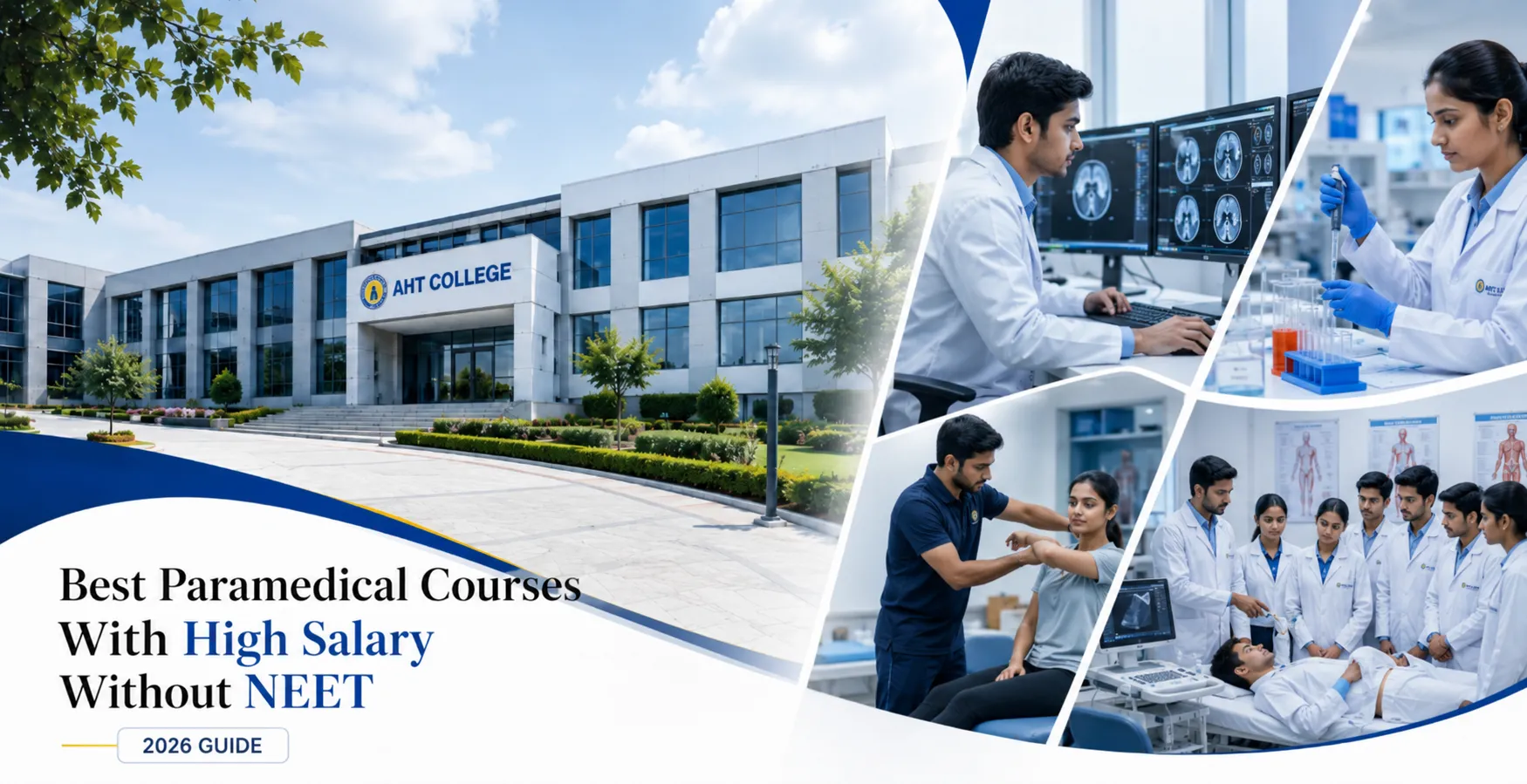
Every year around May, the same scene repeats itself in lakhs of Indian homes. NEET results come out, and for a huge number of students, the rank just doesn't add up to an MBBS seat. Parents panic. Students Google frantically at midnight. And somewhere in that scramble, a genuinely good option gets overlooked simply because nobody explained it properly: paramedical courses.
Here's the thing nobody tells you in Class 12 career counselling sessions — you don't need NEET to build a real, respected, well-paying career in healthcare. Hospitals don't run on doctors alone. Behind every accurate CT scan, every successful surgery, every lab report that catches a disease early, there's a trained paramedical professional doing work that's every bit as skilled as it is essential. And increasingly, it's work that pays well too.
I've spent enough time around hospital corridors and diagnostic centres to notice a pattern: the professionals who get promoted fastest, who get poached by bigger hospitals, who eventually run entire departments, are rarely the ones who "just got a degree." They're the ones who picked a specialised, hands-on field early and stuck with it. That's exactly what a good B.Voc paramedical program is built for.
Let's go through five courses that consistently show up on hiring lists, without a NEET score anywhere in the eligibility criteria.
1. Radiology & Medical Imaging Technology
If you had to bet on one paramedical field with the least chance of ever running out of demand, imaging technology would be it. Every hospital with more than 50 beds needs someone who can run an X-ray machine, assist with a CT scan, or work alongside a radiologist on MRI procedures. And that "someone" isn't the doctor — it's a trained radiology technician.
What makes this field interesting is how much of the job is invisible to patients. People see the final image on a screen and assume the machine did all the work. In reality, correct patient positioning, radiation safety, and image quality checks are entirely the technician's responsibility, and a small mistake here can mean a misdiagnosis. That responsibility is exactly why hospitals pay for skilled hands.
Fresh graduates typically start somewhere in the ₹2.5–4 LPA range, and with a couple of years of experience — especially if you're comfortable across digital radiography, CT, and MRI support — that climbs steadily upward, with senior imaging technologists in metro hospitals and diagnostic chains earning considerably more. Programs like the B.Voc in Radiology & Medical Imaging Technology at AHT College are built around this reality, with lab training on digital and computed radiography and a proper hospital-based clinical internship, not just classroom theory.
2. Operation Theatre (OT) Technology
Walk into any operation theatre and you'll notice something interesting — the surgeon is rarely the only person who's technically "in charge" of that room. There's an OT technologist quietly making sure instruments are sterile, equipment is functioning, anaesthesia support is ready, and the entire surgical environment is safe before, during, and after the procedure.
This is one of those careers where the learning curve is steep but so is the payoff. OT technicians are needed in every hospital that performs surgery — which is to say, almost every hospital — and multi-specialty and trauma centres in particular are often short-staffed on trained OT professionals. It's demanding work, no doubt, often involving long or irregular hours, but it also builds you into someone genuinely indispensable in a surgical unit.
Salary-wise, this sits comfortably among the better-paying paramedical roles, especially once you've built experience in specialised procedures like cardiac or neuro surgeries. The B.Voc in Operation Theatre Technology at AHT College focuses heavily on this practical side — sterilisation protocols, surgical instrument handling, and supervised clinical exposure in real OT settings, which is honestly where this skill is actually learned.
3. Medical Laboratory Technology (MLT)
If radiology is about images and OT is about surgery, medical lab technology is about the numbers and results that quietly drive most clinical decisions. Roughly two-thirds of medical diagnoses today lean on lab test data in some form, and that entire pipeline — blood work, cultures, biochemical tests, pathology samples — runs through trained lab technicians.
What I find underrated about this field is how far it can go. It's not just hospital labs. Diagnostic chains like Dr. Lal PathLabs, SRL, and Metropolis are expanding aggressively across Tier 2 and Tier 3 cities, and every new centre needs qualified MLT staff. Blood banks, research institutions, and even pharmaceutical companies hire for this skill set too, so the career doesn't box you into one type of workplace.
Entry-level lab technicians usually start around ₹2.5–4 LPA, with specialists in areas like microbiology, haematology, or biochemistry earning noticeably more as they gain certifications and experience. The B.Voc in Medical Laboratory Technology at AHT College is designed to get students comfortable with real diagnostic workflows early, rather than leaving lab skills to be figured out on the job.
4. Dialysis Technology
This one doesn't get talked about enough, and honestly, it should. India's kidney disease burden is significant and growing, driven by rising diabetes and hypertension cases, and dialysis units are one of the more consistently short-staffed departments in hospitals. A trained dialysis technician operates and monitors dialysis machines, manages patient safety during sessions, and handles the technical and hygiene protocols that keep the whole process safe.
It's a specialised, almost niche skill compared to radiology or lab technology, and that scarcity works in your favour. Dialysis technicians are in steady demand in both standalone dialysis centres and hospital nephrology departments, and because relatively fewer students specialise here, experienced technicians often find themselves with strong bargaining power and quicker growth into supervisory roles. Starting salaries are broadly comparable to other diploma-level paramedical roles, with clear upward movement as centres expand — India currently has far more dialysis patients than trained technicians to serve them.
5. Cardiac Care & ECG Technology
Heart disease remains one of India's leading causes of death, and cardiac care units, cath labs, and cardiology departments all depend on technicians trained specifically in ECG monitoring, cardiac diagnostics, and supporting cardiologists during procedures. This is a field where the demand curve is only going up, given how much cardiovascular disease has increased across age groups in the last decade.
Cardiac care technicians work in some of the most fast-paced, high-stakes environments in a hospital, which also means it's a field that rewards precision and calm under pressure. Professionals in cardiac and cath lab technology are among the better-compensated paramedical roles, with early-career salaries often in the ₹4 LPA range and meaningful jumps for those who go on to specialise in cath lab procedures or invasive cardiology support.
A Quick Reality Check Before You Choose
Here's something worth being honest about: BPT (Bachelor of Physiotherapy) is technically a paramedical course too, and it's a genuinely rewarding one — but it's the one major exception where NEET is required for admission. If your goal is specifically to avoid NEET altogether, the five courses above are where you should be looking.
The other thing I'd say, having seen this play out with plenty of students, is that salary shouldn't be the only filter. The technicians who end up earning the most, fastest, are almost always the ones who actually enjoyed the daily grind of their field — the person genuinely curious about how imaging equipment works, or the one who doesn't flinch in a surgical environment. Pick based on that instinct first, and let the salary catch up, because in paramedical careers, it usually does.
If you're still deciding between radiology, OT technology, or medical lab science, it's worth spending time on the detailed course pages, comparing curriculum, clinical exposure, and placement support before you commit three years of your life to one path.