
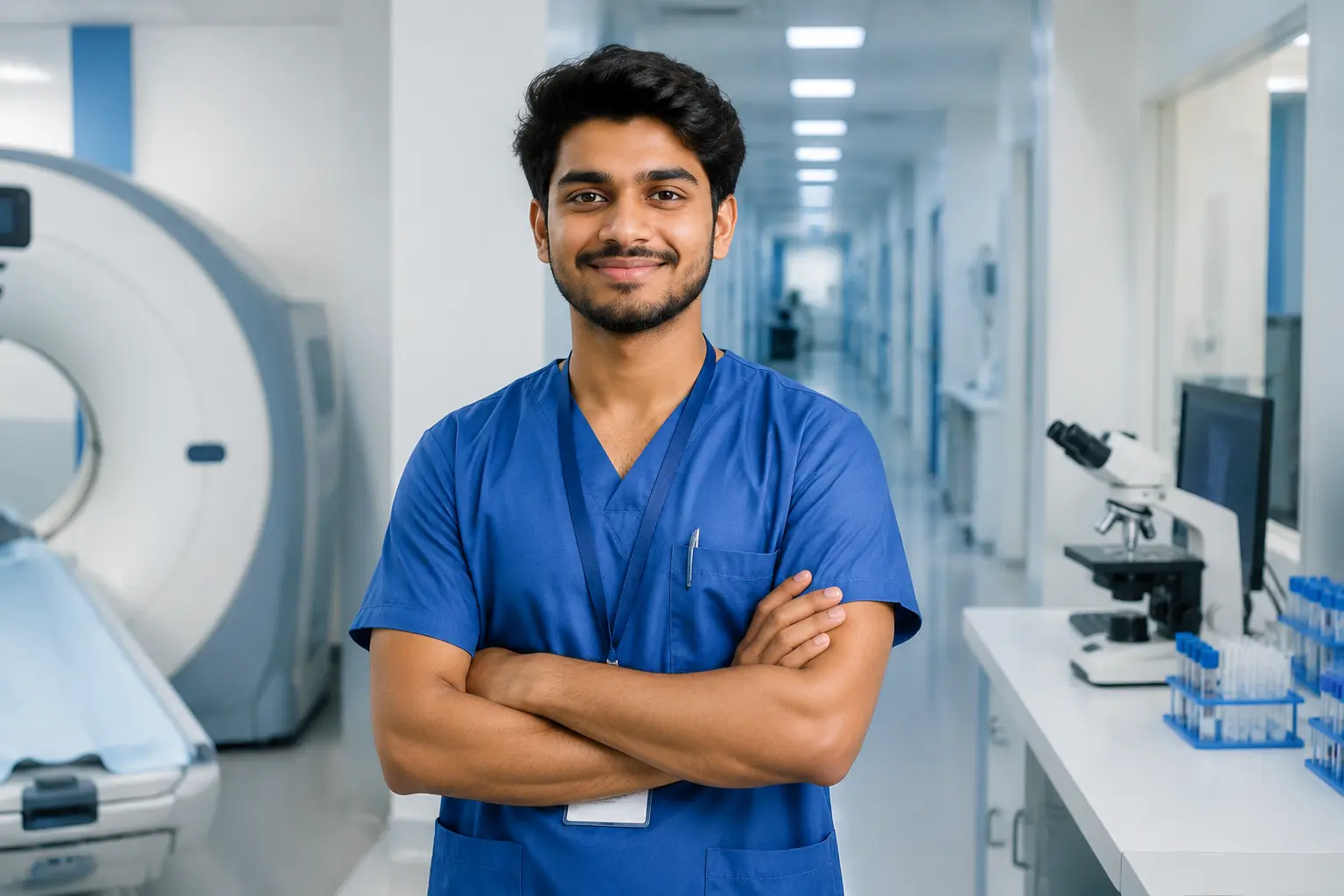
So you've just finished your 12th — and everyone around you is either talking about MBBS, engineering, or MBA. But here's something most career counsellors don't tell you early enough: the healthcare industry is much bigger than just doctors and nurses.
Paramedical professionals are the backbone of every hospital, diagnostic centre, and surgical unit in the country. And right now, India is facing a significant shortage of trained paramedical talent — which means the career opportunity here is real, growing, and well-paying.
This guide covers the best paramedical courses after 12th: what they actually involve, who they're best suited for, what you can earn, and which specialisations are worth your time in 2026.
What Are Paramedical Courses, Really?
Paramedical courses train healthcare support professionals — the people who run diagnostic tests, operate imaging machines, assist in surgeries, prepare labs, and keep the clinical side of healthcare functioning. They work alongside doctors and surgeons, but they're not doctors themselves.
These are skill-based, hands-on programs. You spend time in labs and clinical environments, not just classrooms. Most are available at the diploma, B.Voc (Bachelor of Vocation), or degree level — and you can start right after 12th.
The demand is consistent. Every new hospital, diagnostic chain, or surgical centre that opens needs radiology technicians, OT technicians, and lab technicians before it can see a single patient.
Who Should Consider Paramedical Courses After 12th?
Paramedical is a good fit if:
- You're from a Science background (PCB especially) and want to stay in healthcare
- You don't want to spend 5–6 years on MBBS but still want clinical work
- You're interested in technology — imaging machines, lab equipment, surgical instruments
- You want stable employment with real growth potential
- You're looking for something that leads directly to a job, not just a degree
You don't need a perfect score or a top rank. You need interest in healthcare and willingness to work in clinical environments.
12th Paramedical Courses List: Top Options to Know
Here's a structured look at the courses worth seriously considering — covering both undergraduate and postgraduate options.
1. B.Voc in Radiology and Medical Imaging Technology
This is one of the most in-demand paramedical specialisations today — and for good reason. Radiology is everywhere in clinical care. Whether it's a fracture, a tumour, an internal organ issue, or a cardiac condition, imaging is almost always part of the diagnosis.
As a radiology technician, you operate equipment like X-ray machines, CT scanners, MRI units, and ultrasound systems. You position patients correctly, ensure image quality, follow radiation safety protocols, and assist radiologists in reading and interpreting scans.
What you'll study: X-Ray techniques, CT and MRI fundamentals, ultrasound basics, patient positioning, radiation physics, contrast procedures, imaging anatomy.
Who hires you: Hospitals, diagnostic imaging centres, trauma and emergency units, specialty clinics, private radiology practices.
Typical starting salary: ₹2.5 – ₹6 LPA. Senior and specialised roles go considerably higher.
Eligibility: 10+2 with Science (PCB or PCM). Biology background is useful but not always mandatory.
If diagnostic imaging interests you, the B.Voc in Radiology and Medical Imaging Technology is one of the stronger career entry points in allied health.
2. B.Voc in Operation Theatre Technology
Operation Theatre Technology is one of those roles that sounds intimidating until you understand it — and then it makes complete sense. OT Technicians are present in every surgery. They prepare the operation theatre, manage surgical instruments, maintain sterility, assist the surgical team during procedures, and handle post-operative tasks.
This is a high-responsibility, high-precision role. Surgeons count on OT technicians for seamless instrument handling and infection-free environments. It's not glamorous in the way TV shows make surgery look, but it's critical — and it's steady work in every hospital with a surgical department.
What you'll study: Surgical instruments and their classification, sterilisation and infection control, OT setup and protocols, anaesthesia support basics, patient draping, emergency response in OT settings.
Who hires you: Government and private hospitals, multispeciality surgical centres, trauma hospitals, day surgery clinics.
Typical starting salary: ₹2 – ₹5 LPA. Experienced OT technicians in large hospitals earn more.
Eligibility: 10+2 with Science stream from a recognised board.
Learn more about the career path and curriculum through the B.Voc in Operation Theatre Technology program.
3. B.Voc in Medical Laboratory Technology
Behind every diagnosis is a lab report. Doctors depend on blood counts, urine analysis, microbiological cultures, biochemistry panels, and histopathology results before prescribing treatment. Medical Lab Technicians (MLTs) are the people who run these tests and deliver those reports accurately.
This course trains you in clinical pathology, biochemistry, microbiology, haematology, and immunology — and gives you hands-on time with lab instruments, sample processing, and quality control. As diagnostic chains like Metropolis, SRL, and Thyrocare have expanded across India, the demand for qualified lab professionals has grown with them.
What you'll study: Clinical pathology, blood banking, microbiology and culture techniques, biochemical analysis, haematology, lab equipment calibration, sample handling and safety.
Who hires you: Diagnostic laboratories, hospital pathology departments, blood banks, research labs, pharmaceutical companies.
Typical starting salary: ₹2.5 – ₹5.5 LPA, with senior roles and quality assurance positions paying more.
Eligibility: 10+2 with Science, Biology preferred.
The B.Voc in Medical Laboratory Technology covers both the technical and the clinical aspects of lab work, which makes graduates employable across a wide range of healthcare settings.
4. B.Sc in Medical Imaging Technology
Similar to radiology B.Voc programs but often offered at affiliated university colleges, this degree covers similar ground — diagnostic imaging, radiographic techniques, and patient care in imaging departments. Some students prefer this route if they want a formal university degree attachment for further studies or government job applications.
The course typically runs 3 years and covers X-ray, CT, MRI, mammography, and angiography alongside anatomy and pathology basics.
5. B.Sc in Optometry
Not everyone thinks of optometry as paramedical, but it falls squarely in the allied health category. Optometrists assess vision, diagnose refractive errors, prescribe corrective lenses, and support ophthalmologists in eye care clinics.
With increasing screen time across age groups, vision-related issues are on the rise — and so is demand for trained optometrists in both hospital settings and private clinics.
6. B.Sc / Diploma in Physiotherapy
Physiotherapy is an established career with strong long-term demand, particularly in geriatric care, sports medicine, post-surgical rehabilitation, and neurological recovery. The B.Sc runs 4.5 years including internship; diploma programs are shorter and narrower in scope.
7. Diploma in Medical Laboratory Technology (DMLT)
For students who want to enter the workforce faster, DMLT is a 2-year program covering the basics of laboratory testing and diagnostic procedures. It's a practical entry-level qualification, though career growth typically favours those who upgrade to B.Voc or B.Sc level eventually.
8. Diploma in X-Ray Technology / Radiography
Another shorter route into radiology — this diploma usually runs 1–2 years and focuses on basic X-ray procedures and radiation safety. Suitable for students looking for quick employment in smaller diagnostic setups, though larger hospitals increasingly prefer degree-holders.
"If you're based in Delhi NCR, you can find all these programs and more at Paramedical Courses in Delhi NCR — with details on intake, fees, and admission."
Postgraduate Options: Deepening Your Expertise
If you've completed a B.Voc or B.Sc in a paramedical field and want to move into senior roles, supervisory positions, or specialised work, postgraduate programs are the logical next step.
The Paramedical Courses After 12th guide covers M.Voc programs in both Medical Laboratory Technology and Radiology — both of which open up roles like Laboratory Supervisor, Senior Imaging Technologist, and Diagnostic Consultant.
M.Voc programs are increasingly relevant as hospitals and diagnostic chains look for staff who can manage teams, handle quality control, and navigate more complex diagnostic situations.
What Does the Job Market Actually Look Like?
India's healthcare sector is growing fast — driven by new hospital infrastructure, increasing health insurance penetration, and rising diagnostic awareness among the population. The National Health Mission and private hospital expansion projects in tier-2 and tier-3 cities are creating demand for paramedical staff far beyond what existing institutions can currently supply.
Specific factors driving demand:
Radiology: India has been steadily increasing its CT and MRI installation base. Every new imaging unit needs trained technicians to operate it. AI-assisted radiology is also growing — but it needs trained humans to manage patient workflows, quality checks, and complex cases.
OT Technology: Surgical volumes are increasing year-on-year, both in elective and emergency categories. Government health schemes have made surgeries more accessible to lower-income populations, directly growing OT staff requirements.
Medical Lab Technology: Diagnostic chains continue to expand. The post-COVID period saw permanent growth in health awareness and voluntary testing, which has sustained higher lab testing volumes across India.
Salary Expectations: An Honest Look
Starting salaries in paramedical fields are modest but grow meaningfully with experience and specialisation.
| Specialisation | Entry Level | Mid-Level (3–5 yrs) | Senior/Specialised |
|---|---|---|---|
| Radiology Technician | ₹2.5 – 4 LPA | ₹4 – 7 LPA | ₹7 – 12 LPA |
| OT Technician | ₹2 – 3.5 LPA | ₹3.5 – 6 LPA | ₹6 – 10 LPA |
| Medical Lab Technician | ₹2.5 – 4 LPA | ₹4 – 6.5 LPA | ₹6.5 – 10 LPA |
Location matters — metropolitan hospitals pay more than tier-3 towns. Private multispeciality hospitals often pay more than government setups at entry level, though government positions offer job security and benefits.
How to Choose the Right Paramedical Course
Here's a practical way to think about it:
Choose Radiology if you're drawn to technology, physics, and diagnostics — and like the idea of operating precision equipment. It's one of the faster-growing areas and has clear specialisation paths (MRI, CT, interventional radiology).
Choose OT Technology if you're interested in surgical medicine, thrive in fast-paced environments, and can handle high-stakes, precision-focused work. This role puts you at the centre of clinical action.
Choose Medical Lab Technology if you're detail-oriented, methodical, and interested in the science behind diagnosis. Lab work rewards precision and consistency.
If you're still undecided, the Top 5 Paramedical Courses After 12th resource lays out eligibility, career scope, and salary data across all the major options to help you compare.
Conclusion
Paramedical careers are underrated — and that's actually an advantage for students entering the field right now. The demand is high, the workforce gap is real, and the career paths are stable and growing.
You don't need to be a doctor to make a meaningful difference in a patient's care. A radiology technician's scan, a lab technician's report, or an OT technician's preparation can be the thing that changes a patient's outcome.
If healthcare is where you want to be, paramedical courses give you a practical, skill-first path to get there — without the decade-long commitment of medical school.
Start with a course that aligns with your interests. Build your clinical skills. And give yourself room to specialise and grow.