
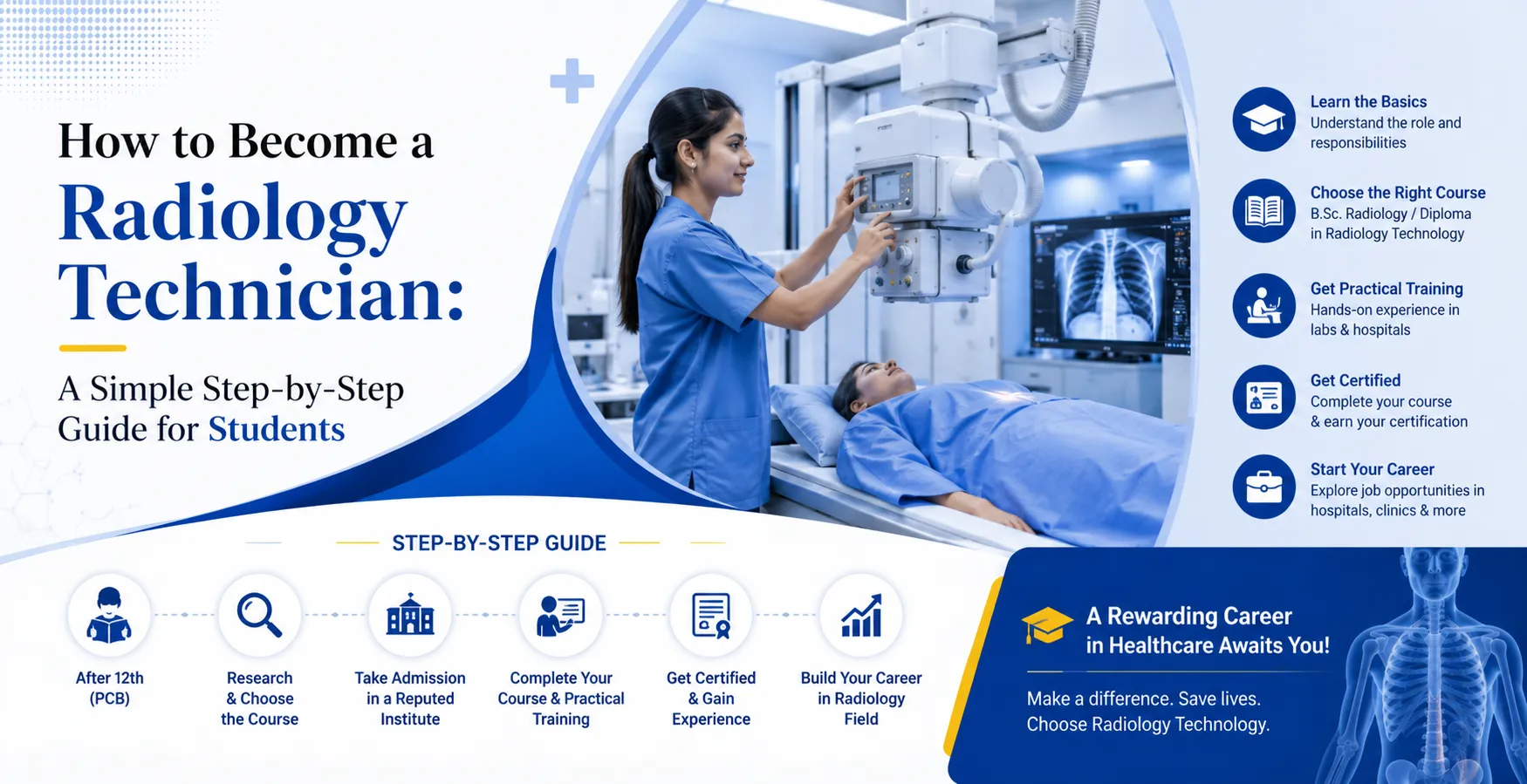
So you've heard about X-rays, CT scans, and MRI machines, and you're thinking — "Can I actually build a career around this?" Good news: yes, you can. And you don't need to become a doctor to do it.
A radiology technician (also called a radiographer or imaging technologist) is the person who actually operates the machine, positions the patient correctly, and captures the image that a doctor later uses to diagnose an illness or injury. It's a hands-on, respected, and genuinely well-paying career — and honestly, it's simpler to get into than most students assume.
Let's break the whole path down into easy steps.
What Does a Radiology Technician Actually Do?
Before jumping into "how," let's quickly cover "what." A radiology technician:
- Operates X-ray, CT scan, MRI, and ultrasound equipment
- Positions patients correctly so the images come out clear and accurate
- Follows radiation safety rules to protect both the patient and themselves
- Works closely with radiologists (the doctors who read the scans) and other hospital staff
- Maintains records and keeps the imaging equipment functioning properly
In short — you're the technical expert who makes sure the picture doctors rely on is done right. No image, no diagnosis. That's how important this role is.
Step 1: Finish Class 12 (Science Stream)
Your journey starts right after Class 12. You'll need to have completed your 12th with Physics, Chemistry, and Biology (PCB) — some colleges also accept PCMB. You generally don't need a high percentage or a NEET score for this field, which is a big relief for a lot of students.
Tip: Even if you didn't do great in NEET, or didn't want to sit for it at all, radiology is still completely open to you.
Step 2: Choose the Right Course
This is the most important decision in the entire process, so take your time here. You have a few options depending on how quickly you want to start working and how deep you want your training to go:
- Certificate course (6 months – 1 year): Fastest option, but limited depth
- Diploma course (1–2 years): A good balance of speed and skill
- B.Voc / Bachelor's degree (3 years): The most thorough option, with stronger job prospects and better starting salaries
If you're serious about this becoming a long-term, stable career (not just a quick job), a degree-level program is usually the smarter investment. A structured course like the B.Voc in Radiology & Medical Imaging Technology at AHT College is built exactly for this — it combines classroom learning with real lab and hospital training, so you're not just memorising theory, you're actually learning to use the equipment.
Step 3: Learn the Core Skills During Your Course
During your training, you'll build skills like:
- Operating X-ray, CT, and MRI machines
- Understanding radiation physics and safety protocols
- Learning correct patient positioning for different body parts
- Reading basic anatomy so you know exactly what needs to be captured
- Handling digital imaging software and equipment maintenance basics
Don't just aim to pass exams — try to actually get comfortable using the machines. The students who take their lab sessions seriously are always the ones who feel confident on day one of their first job.
Step 4: Complete a Clinical Internship
This step matters more than most students realise. Classroom learning teaches you the "why," but a hospital internship teaches you the "how it actually works in real life." During an internship, you'll:
- Work under supervision in a real diagnostic centre or hospital
- Get used to handling actual patients (who aren't always calm or cooperative!)
- Learn how a radiology department runs day-to-day
- Build the confidence to work independently after graduation
A good course will have this internship built directly into the program instead of leaving you to arrange it yourself.
Step 5: Get Certified (If Required)
Depending on your state and the type of institution you studied at, you may need to register with a relevant paramedical or allied health council to officially practice. Your college should guide you through this — it's usually a straightforward paperwork step once you've completed your course.
Step 6: Start Applying for Jobs
Once you're qualified, here's where radiology technicians typically find work:
- Government and private hospitals
- Diagnostic centres and imaging chains (like those doing CT/MRI scans)
- Trauma and emergency care units
- Research institutions
- Even abroad, since imaging skills are in demand internationally too
A quick reality check on salary: most freshers start in the ₹2.5–4 LPA range. It might not sound huge on day one, but this field grows fast — technicians who become skilled across CT, MRI, and digital radiography, or who move to bigger cities and hospitals, often see their pay rise significantly within just a few years.
Step 7: Keep Upgrading Your Skills
Medical imaging technology doesn't stand still — new machines, new software, and new techniques keep showing up. The technicians who stay ahead are the ones who keep learning, whether that's a short certification in MRI specialisation, cardiac imaging, or simply staying updated with the latest equipment their hospital adopts.
If you've already completed your B.Voc and want to go further — into supervisory roles, teaching, or more advanced diagnostic specialisations — you don't have to stop at a bachelor's degree either. An M.Voc in Radiology & Medical Imaging Technology is a natural next step for graduates who want deeper expertise and access to senior positions in hospitals and diagnostic centres.
Is This Career Right for You?
Ask yourself honestly:
- Do you like the idea of working with technology and machines rather than just books?
- Are you okay with being around patients, sometimes in stressful situations?
- Do you prefer a hands-on job over a purely theoretical one?
- Are you looking for a career you can start within 2–3 years, without NEET?
If you said yes to most of these, radiology technology is genuinely worth considering. It's one of those careers that quietly keeps the entire healthcare system running — every diagnosis, every treatment plan, every surgery often starts with an image that a technician like you would have captured.
Final Thoughts
Becoming a radiology technician isn't complicated once you break it down — finish Class 12, pick the right course, actually learn the equipment (not just the theory), do your internship seriously, and start applying. What matters most is choosing a course that gives you real hands-on training instead of just a certificate on paper, because in this field, employers care far more about what you can actually do than what your marksheet says.