
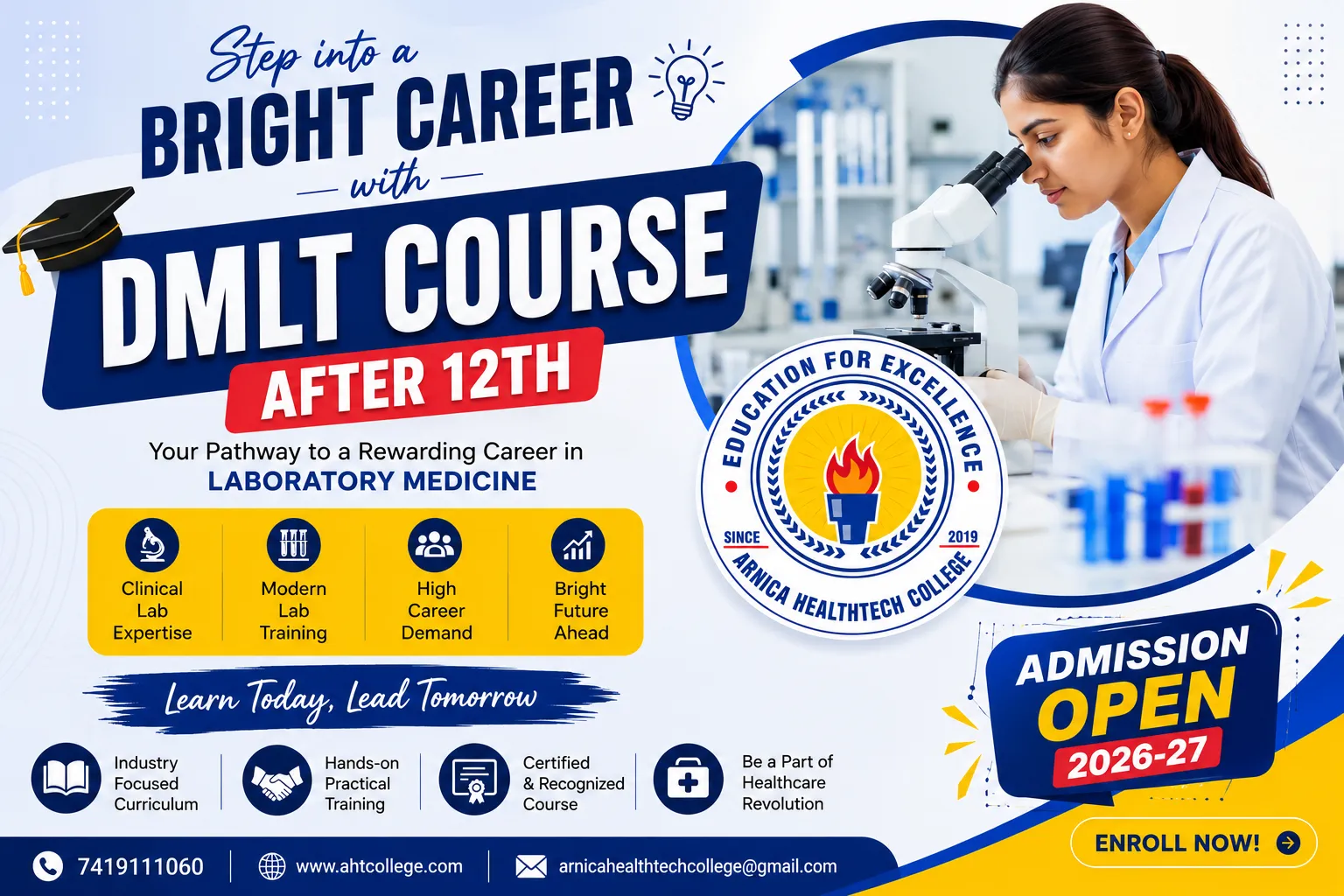
If you have just finished your 12th and you are looking for a medical career that does not take five or six years to complete, the DMLT course after 12th is one of the best options in front of you. DMLT stands for Diploma in Medical Laboratory Technology, and it trains you to work in a diagnostic lab, collecting and testing blood, urine and other body samples that doctors use to understand what is wrong with a patient. It is a practical, hands on course, and most students finish it and step into a paying job much faster than they would with a full medical degree.
In this blog, we will walk you through everything you need to know about the diploma in medical laboratory technology after 12th, including who can apply, how long it takes, what you study, and where it can take your career.
Not sure if this course is right for you, or want help picking the best college? Feel free to send an enquiry and our counsellors will guide you through the entire process, from eligibility to admission.
What Is the DMLT Course?
DMLT is a diploma program that focuses on the science and practical skills behind medical laboratory testing. Students learn how to draw blood samples, prepare slides, operate lab equipment, run tests on samples, and read results accurately. It also covers subjects like human anatomy, physiology, biochemistry, microbiology, pathology and hematology, so students understand the "why" behind every test they run, not just the steps.
Because it is a diploma and not a degree, the DMLT course after 12th is shorter and more focused on job ready skills than a full B.Sc in medical lab technology would be. It is a good fit for students who want to start earning sooner while still building a proper foundation in medical science.
Why the Course Matters in Healthcare
Every hospital, clinic, diagnostic centre and pathology lab depends on trained lab technicians. Doctors cannot diagnose most conditions without lab reports, and this is exactly the gap that DMLT trained professionals fill. As more diagnostic centres open across India and testing volumes keep rising, the need for qualified lab technicians is only growing, which makes this a fairly secure career choice.
DMLT Course Eligibility After 12th
One of the most common questions students ask is whether they need a science background to apply. Here is a simple breakdown.
DMLT Course After 12th Science
This is the most common and widely accepted route. If you have completed your 12th with Physics, Chemistry and Biology, you meet the eligibility criteria for almost every college offering this diploma. Some institutes also accept Physics, Chemistry and Mathematics in place of Biology, though this depends on the specific college.
DMLT Course After 12th Arts
Very few institutes accept students from the arts stream directly. If you are from arts and interested in this field, you will need to check with individual colleges, since eligibility rules differ a lot from one institute to another. Some colleges are open to it as long as you meet their minimum marks requirement, so it is worth confirming with the admission office before ruling it out.
DMLT Course After 12th Commerce
Similar to arts, commerce students may find limited options for a DMLT course after 12th commerce. A handful of institutes do accept commerce background students, especially if there is some flexibility in their entry requirements, but science stream students generally have a much smoother admission process. If you are from a non science background, it is a good idea to speak with the college directly and confirm before applying.
If you are still in school and want to explore an earlier entry point into this field, you can also look at the diploma in medical laboratory technology after 10th, which is designed for students who want to start even sooner.
DMLT Course Duration
Most DMLT programs run for two years, split into four semesters. Some institutes also offer a shorter one year certificate style version for students who want a quicker entry into the workforce, though the two year diploma is more common and generally more recognised by employers. The course usually combines classroom teaching with laboratory practicals and clinical training, so students get real, hands on exposure well before they graduate.
What a Typical Semester Looks Like
Each semester usually mixes theory subjects with practical lab sessions. In the early semesters, students focus on the basics like anatomy, physiology and biochemistry. As the course progresses, subjects become more specialised, covering areas like microbiology, hematology, clinical pathology and blood banking. By the final semester, most students are working directly with lab equipment and real sample testing under supervision.
DMLT Course Syllabus
While the exact subjects can vary a little from one college to another, most DMLT programs cover the following core areas:
- Human anatomy and physiology
- Biochemistry
- Microbiology
- Clinical pathology
- Hematology
- Histopathology and cytology
- Blood banking and transfusion medicine
- Laboratory management and quality control
Practical Training and Lab Work
Theory alone is not enough in this field, which is why practical training makes up a large part of the DMLT course. Students get trained on real lab instruments, learn to collect samples correctly, and practice preparing and reading test results. This hands on exposure is what makes DMLT graduates job ready as soon as they finish the course, rather than needing extensive on the job training later.
Career Scope After DMLT
Once you complete the DMLT course after 12th, a number of job roles open up in the healthcare and diagnostics sector. You can work as a lab technician, lab assistant, or phlebotomist in hospitals, diagnostic centres, blood banks, pathology labs and even pharmaceutical companies. Government hospitals and health departments also hire DMLT qualified technicians regularly, so there are both private and public sector opportunities.
Common Job Roles
- Medical Laboratory Technician
- Lab Assistant
- Phlebotomist
- Blood Bank Technician
- Pathology Lab Technician
- Research Lab Assistant
Salary Expectations
Starting salaries for freshers typically fall in a modest but steady range, and this tends to grow with experience and specialisation. Technicians who continue building their skills, take up additional certifications, or move into supervisory roles in larger diagnostic chains generally see their pay increase over time.
Higher Studies After DMLT
DMLT is not necessarily the end of the road. Many students use it as a stepping stone and later pursue a B.Sc in Medical Laboratory Technology or specialise further in areas like microbiology or pathology. If you already have a bachelor's degree or are considering an alternate route, you might also want to look at the BVoc in Medical Laboratory Technology, which combines vocational training with a degree level qualification.
DMLT Compared to Other Paramedical Options
DMLT is just one of several paramedical courses students can take up after 12th. If you are still exploring your options, it helps to compare a few before deciding. You can read our detailed guide on paramedical courses after 12th to see how DMLT stacks up against other diploma programs in terms of duration, cost and career scope.
Choosing the Right College
Picking the right college matters just as much as picking the right course. Look for institutes with proper lab infrastructure, experienced faculty, and tie ups with hospitals or diagnostic centres for practical training and internships. If you are based in or around the capital, our guide on paramedical courses in Delhi NCR can help you compare local options.
For a broader look at what this course covers and how admissions typically work, you can also check our detailed page on MLT course details after 12th.
Is DMLT the Right Choice for You?
If you enjoy science, do not mind precise, detail oriented work, and want to start working in the healthcare field without committing to a long degree program, DMLT after 12th is a solid choice. It gives you a stable, in demand skill set, a reasonably short course duration, and a clear path into hospitals, labs and diagnostic centres right after you graduate.
If you still have questions about eligibility, fees or admission timelines, do not hesitate to send an enquiry and our team will help you figure out the right next step.