
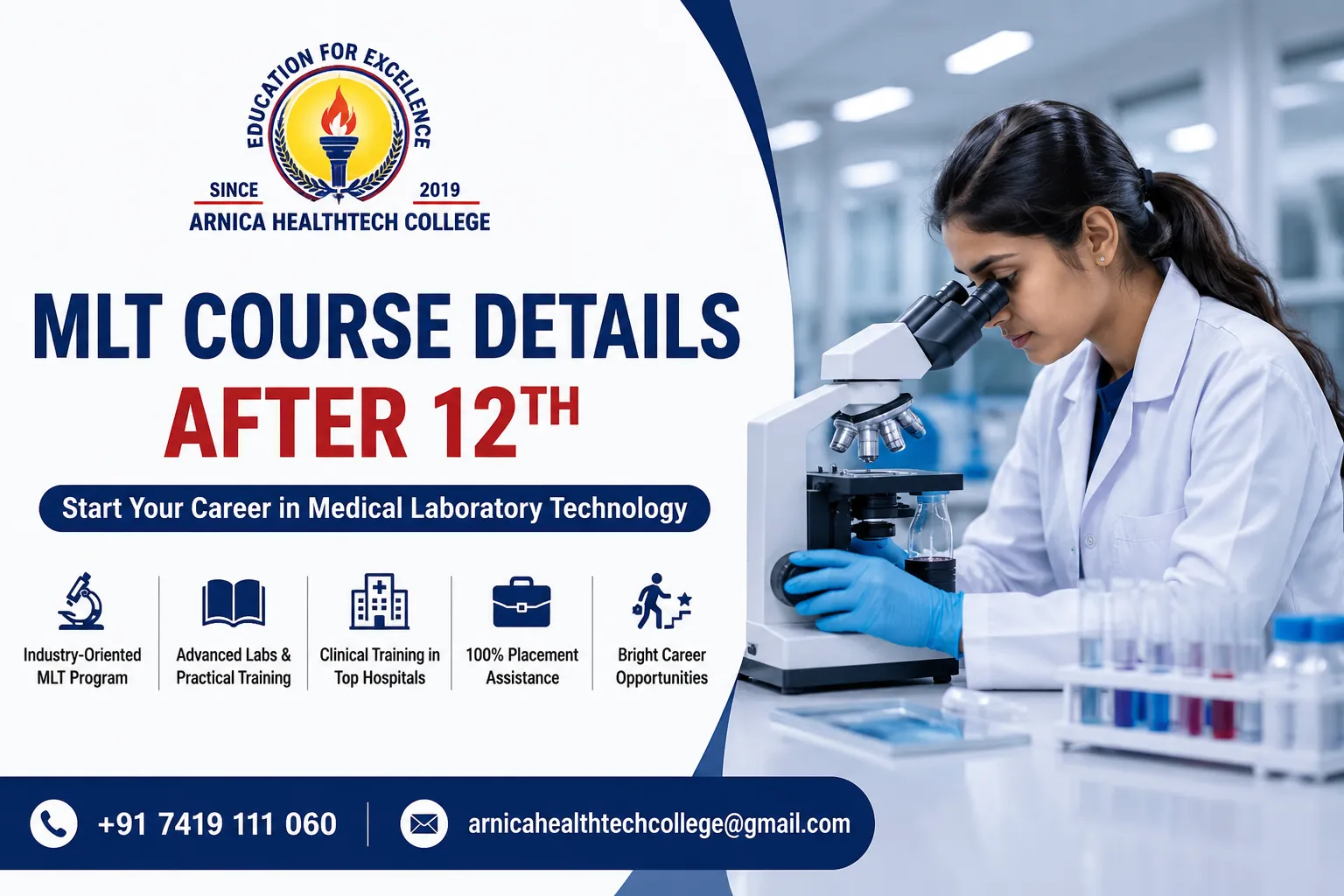
The short answer is yes. But the path has more branches than most 12th-pass students realise, and picking the wrong one can cost you a year. This guide walks through everything: eligibility, structure, curriculum, career outcomes, and the mistakes students commonly make when choosing an MLT course after 12th.
What Is an MLT Course
MLT stands for Medical Laboratory Technology. It's the field concerned with collecting, processing, and analysing biological samples such as blood, urine, and tissue to help diagnose disease.
An MLT course after 12th trains you to work in pathology labs, blood banks, diagnostic centres, and hospital laboratories. You learn to operate lab equipment, run biochemical and microbiological tests, and report results accurately under supervision of a pathologist.
Quick Answer: MLT is a paramedical program that qualifies you to work as a lab technician in hospitals, diagnostic chains, and research labs, typically completed as a 3-year B.Voc degree or a 2-year M.Voc after a related diploma.
Why MLT Is a Smart Choice After 12th
Healthcare in India is expanding fast, and diagnostics is one of its quietest growth engines. Every new hospital, every diagnostic chain opening a branch in a tier-2 city, needs trained lab technicians on day one.
A few reasons this field keeps attracting 12th-pass students:
- Shorter, more affordable path into healthcare compared to MBBS or BDS
- Consistent demand across government hospitals, private labs, and diagnostic chains
- Clear skill-based progression, from technician to lab supervisor to specialist
- Works well for science, and in specific cases, non-science backgrounds too
I've noticed that most students discover MLT almost by accident, after realising NEET or a full medical degree isn't the only route into healthcare. Once they understand the scope, it usually becomes the preferred choice rather than a backup one.
Eligibility for MLT Course After 12th
This is where most confusion happens, especially around which stream qualifies.
MLT Course After 12th Science
This is the standard, most direct route. Students who complete 12th with Physics, Chemistry, and Biology (PCB) are eligible for B.Voc MLT without any bridge requirement. Most colleges, including AHT College, treat science-with-biology as the core eligible stream because the curriculum builds directly on biology and chemistry fundamentals.
MLT Course After 12th Arts or Commerce
Can arts or commerce students take up MLT? This question comes up constantly, and the honest answer is: it depends on the institute and the specific program structure.
Some vocational (B.Voc) frameworks are designed to be stream-agnostic at entry, with foundational science bridging modules built into the first year specifically to bring non-science students up to speed. If you're from an arts or commerce background and serious about an mlt course after 12th arts or mlt course after 12th commerce, always confirm with the admissions office whether bridging modules are included, because not every college offers this flexibility.
Important Note: Do not assume every MLT program accepts non-science students. Always verify eligibility criteria directly with the institute before applying, since UGC-aligned vocational degrees can differ in their entry requirements.
| Stream | Direct Eligibility | Typical Requirement |
|---|---|---|
| Science (PCB) | Yes | 12th pass, Biology mandatory |
| Science (PCM) | Usually, program-dependent | 12th pass, check Biology requirement |
| Commerce | Program-dependent | Foundational bridging module may apply |
| Arts | Program-dependent | Foundational bridging module may apply |
B.Voc MLT vs M.Voc MLT: What's the Difference
One mistake I often see is students assuming B.Voc and M.Voc are just different names for the same course. They're not.
B.Voc MLT is a 3-year undergraduate vocational degree, taken directly after 12th. It combines classroom theory with structured hands-on lab training, building you from a fresher into a job-ready technician by graduation.
M.Voc MLT is a 2-year postgraduate vocational program, meant for students who already hold a diploma or B.Voc in a related field and want to move into supervisory or specialised diagnostic roles.
| Aspect | B.Voc MLT | M.Voc MLT |
|---|---|---|
| Duration | 3 years | 2 years |
| Entry Point | After 12th | After diploma/B.Voc |
| Level | Undergraduate | Postgraduate |
| Focus | Foundational + practical training | Advanced, specialised skills |
| Typical Outcome | Entry-level lab technician | Senior technician, lab supervisor |
If you're straight out of 12th, B.Voc MLT is almost always the correct starting point.
What You'll Actually Study
A well-structured MLT course after 12th covers both theory and applied lab work across three years. Broadly, the curriculum includes:
- Human Anatomy and Physiology – understanding body systems relevant to diagnostics
- Clinical Biochemistry – analysing blood chemistry, enzymes, and metabolic markers
- Microbiology – identifying pathogens through culture and staining techniques
- Hematology – blood cell counting, clotting studies, and related disorders
- Histopathology – tissue sample processing and slide preparation
- Blood Banking – blood grouping, cross-matching, and transfusion safety
- Lab Instrumentation – operating analysers, centrifuges, and microscopy equipment
- Quality Control and Lab Safety – maintaining accuracy and biosafety standards
From working with students who've gone through this training, the practical component matters far more than the textbook one. Employers care less about your theory scores and more about whether you can independently run a sample panel without supervision.
Did You Know? According to WHO guidelines on laboratory quality management, consistent quality control practices are considered essential to reducing diagnostic error, which is exactly why lab safety and QC form a core, non-optional part of every recognised MLT curriculum.
Skills You'll Build
By the end of an MLT course after 12th, you should be confident in:
- Sample collection and handling protocols
- Operating semi-automated and automated lab analysers
- Interpreting basic test results within a diagnostic framework
- Maintaining lab records and following documentation standards
- Following infection control and biosafety practices
- Communicating clearly with patients and supervising pathologists
These aren't abstract skills. They're exactly what a diagnostic centre or hospital lab expects on your first day of duty.
Career Scope After MLT
Many people are surprised when they learn how wide the employment base for MLT graduates actually is. It isn't limited to hospitals.
Common career paths include:
- Medical Lab Technician in hospitals and nursing homes
- Diagnostic centre technician (pathology, radiology-linked labs)
- Blood bank technician
- Research assistant in biomedical or pharma labs
- Quality control technician in diagnostic chains
- Further study routes toward M.Voc, specialisation certifications, or lab management roles
Diagnostics is one of the fastest-growing segments within Indian healthcare, driven by rising health awareness and expanding testing infrastructure across both metro and non-metro cities. That growth translates directly into steady technician-level hiring, which is precisely why this remains a dependable choice for 12th-pass students weighing their healthcare career options.
Common Mistakes Students Make
Expert Tip: Choosing a course purely on duration or ease of entry, without checking whether the institute provides real, hands-on lab exposure, is the single biggest mistake I see repeated year after year.
A few other patterns worth avoiding:
- Enrolling without confirming placement support or hospital tie-ups
- Ignoring whether the program is B.Voc/M.Voc recognised versus an unstructured short-term certificate
- Assuming all MLT programs accept non-science backgrounds without verifying first
- Underestimating how much of the course is practical, hands-on lab work rather than lectures
How to Choose the Right MLT College
Before enrolling in any mlt course after 12th, check these points:
- Is the program a recognised B.Voc or M.Voc degree, not just a short certificate?
- Does the curriculum include structured hands-on lab training, not just theory?
- Are there tie-ups with hospitals or diagnostic centres for practical exposure?
- Is there documented placement support after course completion?
- Are faculty experienced in clinical laboratory practice, not only academics?
AHT College structures its B.Voc and M.Voc MLT programs around exactly this kind of practical, industry-aligned training, with lab exposure built into the curriculum from the early semesters rather than left until the final year.
Key Takeaways
- MLT is a 3-year B.Voc degree after 12th, or a 2-year M.Voc after a related diploma
- Science students with Biology have the most direct eligibility path
- Arts and commerce students should confirm bridging module availability before applying
- The curriculum blends anatomy, biochemistry, microbiology, hematology, and hands-on lab instrumentation
- Career scope spans hospitals, diagnostic chains, blood banks, and research labs
- Practical lab exposure matters more than theory scores when it comes to employability
Conclusion
Choosing the right mlt course after 12th comes down to two things: making sure your stream actually qualifies you for direct entry, and picking an institute where the hands-on lab training is real, not just a line in the brochure. Whether you're coming from science, arts, or commerce, the eligibility path is manageable once you know what to ask before applying. If you're ready to take the next step, reach out to AHT College's admissions team to check your eligibility and get a detailed look at the B.Voc and M.Voc MLT curriculum.