
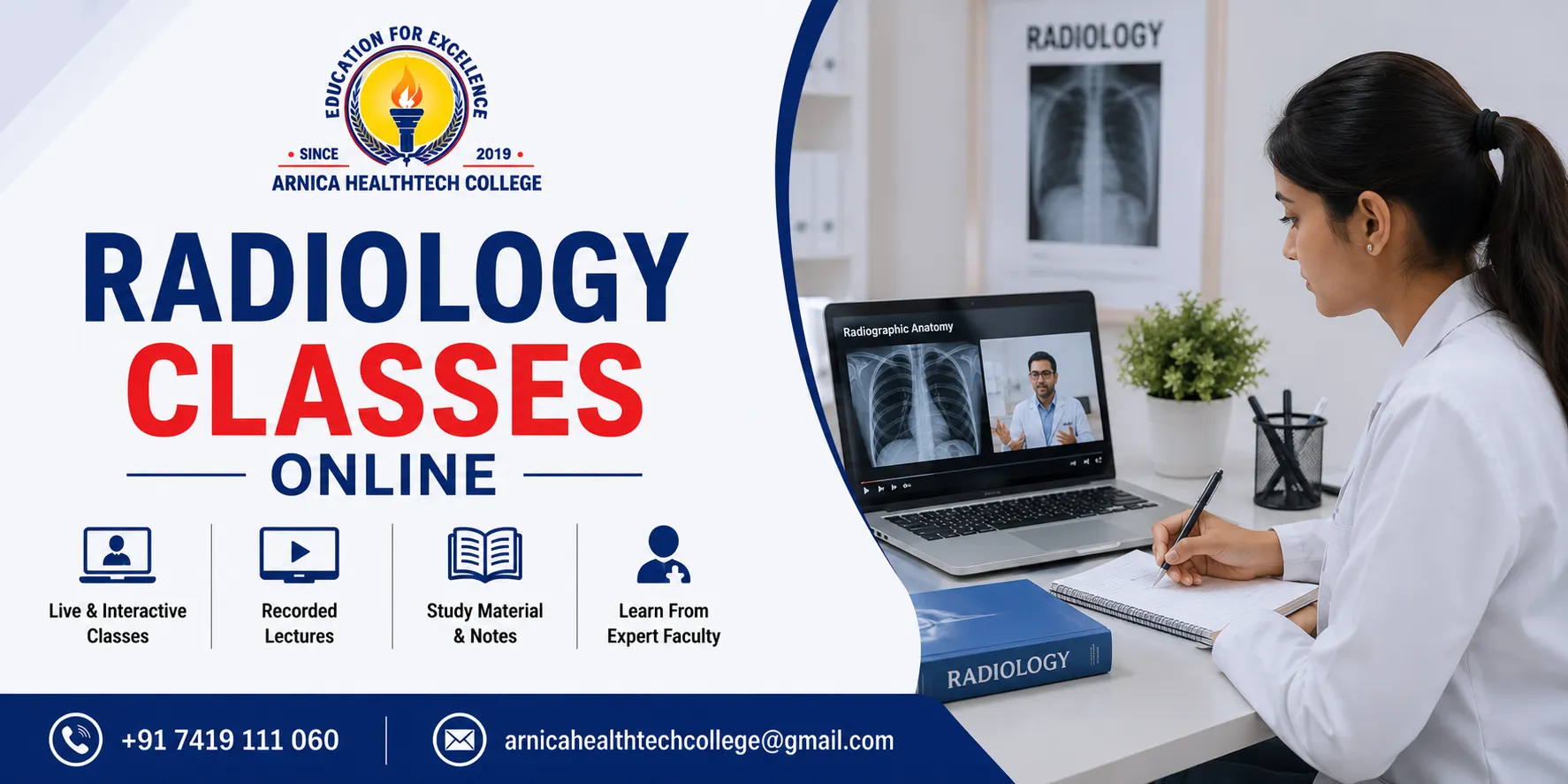
Here's the honest answer. Radiology cannot be learned entirely through a screen. You're training to operate imaging machines, position patients correctly, and read exposures that affect real diagnoses. No online course, however well designed, can teach you to do that alone.
What does exist, and what genuinely works, is a hybrid model. Theory, anatomy, physics of radiation, and imaging concepts are taught online. The hands-on part, operating equipment, working in a hospital or diagnostic setting, positioning real patients, happens offline, in person, under supervision.
In my experience guiding students through this decision, the ones who succeed are the ones who understand this split before they enroll, not after.
Why Fully Online Radiology Courses Don't Hold Up
Search for "online radiology courses with certificates" and you'll find plenty of results. Most of them are short awareness programs, not professional qualifications that lead to hospital employment.
Radiology is a clinical skill. Certification bodies for radiologic technologists, both internationally and in India, require documented clinical hours before certification. India's paramedical framework, overseen through UGC-affiliated institutions and skill universities, follows the same logic. You cannot certify a radiographer who has never stood next to an actual X-ray unit or CT scanner.
I've noticed that students who chase a "radiology degree online" without any offline component often discover this gap only when they apply for jobs. Hospitals ask for practical training records. Diagnostic centers want to see hands-on hours. A certificate without those hours doesn't open doors.
Quick answer: Radiology courses that skip in-person training are not equivalent to accredited radiology technician programs, and employers know the difference.
What a Genuine Hybrid Radiology Course Includes
A properly structured hybrid course, like the one AHT College runs, typically covers two connected halves.
Online component:
- Radiographic physics and radiation safety principles
- Human anatomy and cross-sectional imaging theory
- Equipment fundamentals (X-ray, CT, MRI, ultrasound basics)
- Patient care protocols and medical terminology
- Recorded lectures and assessments you can revisit
Offline component:
- Supervised practice on actual imaging equipment
- Real patient positioning and exposure technique
- Hospital or diagnostic center rotations
- Direct mentorship from practicing radiographers
- Case-based clinical exposure
This structure lets you study theory at your own pace while still walking away with the practical competence employers expect. That's the real value of radiology classes online done correctly, not a shortcut around hands-on work, but a smarter way to sequence it. Whether you call them radiology tech classes or a formal degree program, the credibility test is always the same: does the offline component actually exist, and is it substantial?
Did You Know?
A radiographer's positioning accuracy directly affects diagnostic quality. A poorly angled chest X-ray can hide or exaggerate findings. This is precisely why practical, supervised training isn't optional, no matter how the theory portion is delivered.
B.Voc Radiology and Medical Imaging Technology: How It Works
The B.Voc Radiology and Medical Imaging Technology program is built around this same hybrid logic. It's a full vocational degree, not a short course, and it's designed for students who want a genuine career in diagnostic imaging.
Who it's for:
- Students after Class 12 (Science stream preferred)
- Career changers moving into allied healthcare
- Working individuals who need online flexibility but still want a recognized degree
What you'll study:
Radiographic anatomy, radiation physics, imaging modalities (X-ray, CT, MRI, ultrasound), patient management, and medical ethics. The online modules cover the conceptual groundwork. The offline sessions, conducted at partner hospitals and diagnostic centers, turn that theory into actual skill.
One mistake I often see is students assuming the online portion is the "easy part" they can rush through. It isn't. Understanding radiation physics properly is what keeps you and your patients safe once you're behind the machine.
B.Voc Radiology at a Glance
| Aspect | Details |
|---|---|
| Format | Hybrid (online theory + offline practical) |
| Duration | Multi-year vocational degree |
| Practical training | Hospital and diagnostic center based |
| Eligibility | Class 12 pass (Science preferred) |
| Outcome | B.Voc degree with clinical exposure |
M.Voc Radiology: The Next Step for Working Professionals
For those who already hold a B.Voc or equivalent qualification, M.Voc Radiology builds on that foundation with advanced imaging techniques, specialized modalities, and often a supervisory or teaching-oriented skill set.
Many people are surprised when they learn how much of the M.Voc program can be pursued online, given they already have hands-on grounding from their earlier training. The offline component here tends to focus on advanced modalities and specialized clinical scenarios rather than basic positioning, since that foundation is already in place.
This makes M.Voc Radiology a practical choice for working radiographers who want to move into senior roles, specialized imaging departments, or academic positions without stepping away from their current job entirely.
How to Evaluate Any Radiology Classes Online Program
Before enrolling anywhere, run through this checklist.
Checklist: Is this radiology course actually credible?
- Does it clearly state offline, hands-on hours as part of the curriculum?
- Is it affiliated with a recognized university or approved by a relevant education body?
- Does it mention hospital or diagnostic center tie-ups for practical training?
- Do past students have verifiable placement outcomes?
- Is the faculty made up of practicing radiographers or radiologists, not just online instructors?
If a program can't answer yes to most of these, treat the "online" claim with caution.
Expert Tip: Ask directly how many practical hours are required and where they're conducted. A program that can answer this specifically, rather than vaguely, is usually the more serious option.
Common Mistakes Students Make When Choosing Online Radiology Courses
From working with students across paramedical courses in Delhi, a few patterns repeat often enough to call out.
Assuming online means no commitment. The theory portion still demands consistent study, especially radiation physics and anatomy, which form the backbone of everything practical you'll do later.
Ignoring accreditation. A paramedical course without proper university or UGC-linked affiliation may not be recognized when you apply for registration or jobs.
Underestimating the offline requirement. Some students enroll expecting minimal in-person time and are unprepared for the structured hospital rotations that follow.
Choosing based on convenience alone. Flexibility matters, but not at the cost of practical exposure. A radiology technician without hands-on training is not job-ready, regardless of how strong their online scores are.
Confusing short certificate programs with real degrees. Not every course of paramedical study labeled "radiology" carries the same weight. Some are awareness-level certificates; others are full vocational degrees. Knowing the difference before you enroll saves you a lot of wasted time.
Career Outcomes After a Hybrid Radiology Course
Graduates of a properly structured B.Voc or M.Voc Radiology program typically move into roles such as radiography technician, CT or MRI technologist, diagnostic center staff, and hospital imaging department roles. Some go on to specialize further or move into teaching and supervisory positions after completing M.Voc Radiology.
The demand for trained imaging professionals continues to grow alongside expanding diagnostic infrastructure across India, particularly in Delhi NCR, where diagnostic centers and multi-specialty hospitals are steadily increasing their imaging capacity.
Key Takeaways:
- True radiology classes online always pair theory with mandatory offline, hands-on training
- B.Voc Radiology and Medical Imaging Technology suits students starting fresh after Class 12
- M.Voc Radiology suits working professionals building on existing qualifications
- Accreditation and verifiable hospital tie-ups separate a credible paramedical course from a thin certificate program
- Practical hours are non-negotiable for real employability in this field
At AHT College, this hybrid structure isn't an afterthought, it's the model the paramedical courses in Delhi are built around, precisely because diagnostic imaging is a hands-on discipline that theory alone cannot teach.
Ready to Start Your Radiology Career the Right Way
Radiology rewards people who take both halves seriously, the theory and the hands-on work. If you're searching for radiology classes online because you need flexibility, that's completely reasonable. Just make sure the flexibility doesn't come at the cost of the practical training that actually makes you employable.
In my experience, students who go in understanding this hybrid structure from day one tend to finish stronger and step into hospitals and diagnostic centers with real confidence, not just a certificate.
If you're weighing your options, take a closer look at how AHT College structures its B.Voc and M.Voc Radiology programs, ask about the offline training component specifically, and compare that against anything claiming to be distance learning radiography with no practical exposure. That one question alone will tell you a lot about which programs are serious and which aren't.
Explore the B.Voc Radiology and Medical Imaging Technology program, or reach out to AHT College's admissions team to understand how the online and offline components fit around your schedule.