
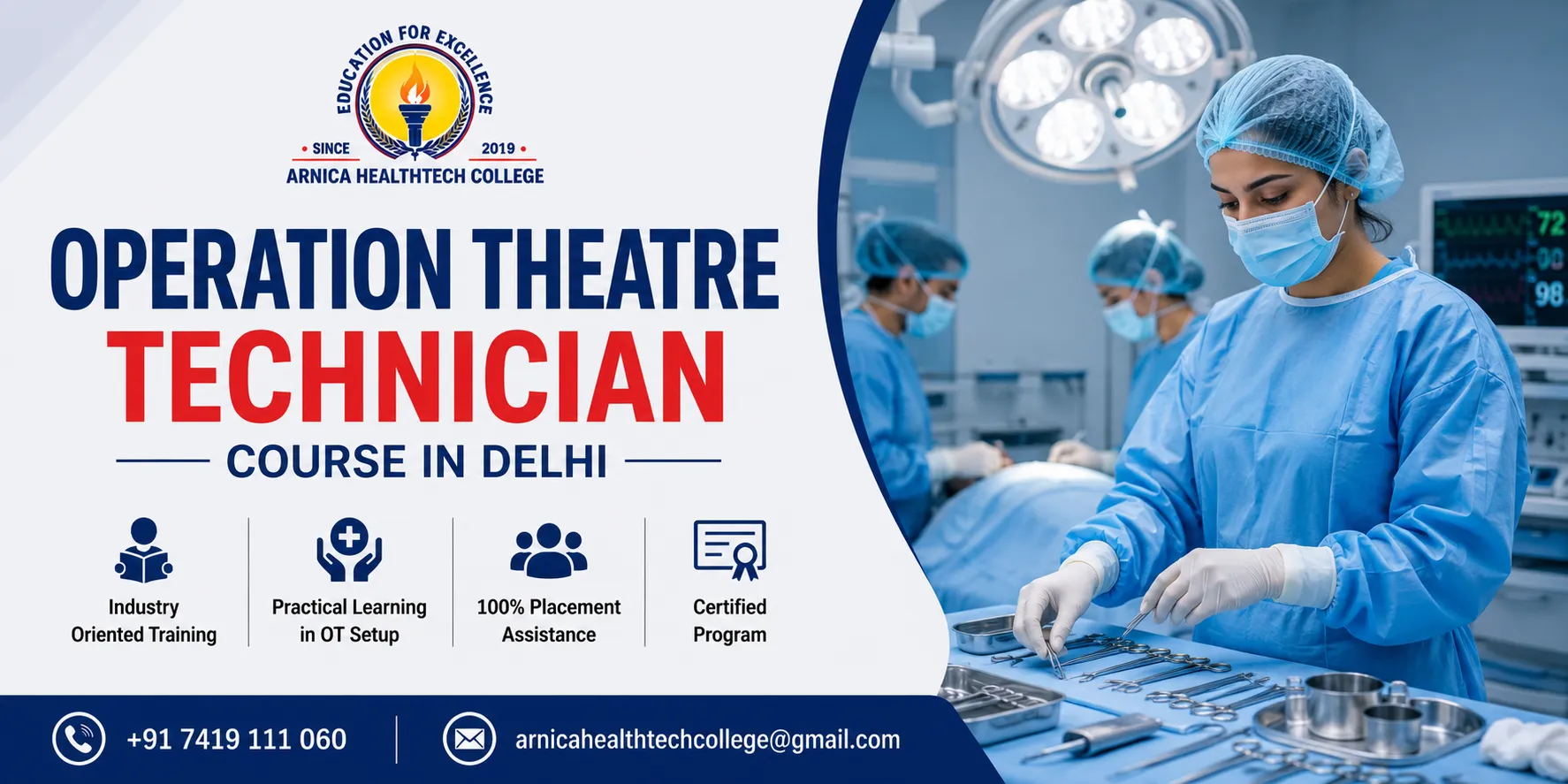
If you're evaluating an OT Technician Course in Delhi and trying to understand what you're actually paying for, this guide breaks it down properly: what factors drive fee differences, how course duration and structure compare across institutes, and how to evaluate value instead of just chasing the lowest number.
What Determines OT Technician Course Fees in Delhi
Quick Answer: Fee structures for an operation theatre technician course in Delhi vary based on the institute's infrastructure, hospital tie-ups, faculty experience, and the depth of practical training included, not just the course name or duration.
Before you compare ot technician course fees in delhi across institutes, it helps to understand what actually drives that cost difference. Two programs both labeled "B.Voc Operation Theatre Technology" can differ significantly in what's included.
Factors That Genuinely Affect Fee Structure
From working with students comparing paramedical courses in Delhi, here's what typically influences fees:
- Quality and modernity of lab and simulation equipment
- Number and strength of hospital partnerships for practical rotations
- Faculty experience, clinical practitioners generally cost more to retain than academic-only staff
- Placement support infrastructure and industry tie-ups
- Accreditation and recognition status of the degree
Important Note: Never compare fee structures in isolation. A lower-cost b voc ott course that skips real hospital exposure often costs you more in the long run through weaker job readiness. Always request the exact fee breakdown, including any additional lab, uniform, or internship-related costs, directly from each institute's admissions office.
What Is an OT Technician Course, Exactly
An operation theatre technician course trains students to assist surgical teams directly, covering sterilisation, instrument handling, patient positioning, and coordination during procedures. It falls under the broader paramedical operation theatre course category, part of the wider course of paramedical education.
Did You Know? According to WHO's surgical safety guidance, standardised protocol adherence in operating theatres directly correlates with fewer surgical complications, which is why every serious ot technician course places heavy emphasis on sterilisation and checklist training regardless of which institute you choose.
Course Duration and Structure
Understanding duration helps you evaluate whether a fee structure makes sense relative to what you're getting.
| Program | Duration | Entry Point | Structure |
|---|---|---|---|
| B.Voc Operation Theatre Technology | 3 years | Directly after 12th | Classroom theory plus hospital-based OT training |
| M.Voc (OT specialisation, where offered) | 2 years | After diploma/B.Voc | Advanced, supervisory-focused training |
A 3-year b voc operation theatre technology program that includes substantial hospital floor time naturally involves more resources than a shorter, classroom-heavy certificate, and that's typically reflected in the fee structure.
Comparing Institutes: What to Actually Evaluate
One mistake I often see is students shortlisting paramedical courses in Delhi purely by comparing brochures side by side. Brochures rarely show you the difference between simulated lab exposure and real hospital OT floor time.
A Practical Comparison Checklist
Before finalising any OT Technician Course in Delhi, verify:
- Is the degree a recognised B.Voc, not an unregulated short-term certificate?
- How many structured, hour-logged hospital OT rotations are included?
- Are hospital partnerships named specifically, not just claimed generally?
- Is placement support documented with actual partner organisations?
- Do faculty members have real clinical OT experience?
| Comparison Factor | Strong Program | Weak Program |
|---|---|---|
| Hospital Training | Hour-logged, named partner hospitals | Vague or simulation-only |
| Faculty | Clinical + academic mix | Academic-only |
| Placement Support | Documented partner list | General "100% placement" claim |
| Curriculum Depth | Multi-semester, progressive | Condensed, theory-heavy |
What You'll Study and Practice
A comprehensive operation theatre technician course covers:
- Human anatomy and physiology relevant to surgical procedures
- Microbiology and sterilisation techniques, including autoclaving and asepsis
- Surgical instrumentation identification and handling
- Anaesthesia assistance fundamentals
- Patient positioning and safety protocols
- OT documentation and safety checklist management
- Emergency response within OT settings
In my experience reviewing paramedical curriculums, the amount of actual hands-on OT floor time matters more than how polished the syllabus looks on paper. Ask specifically how many hours per semester are spent inside a real operation theatre, not a simulation lab.
Who This Course Suits
Ask yourself honestly before enrolling in any ot technician course:
- Are you comfortable working in a fast-paced, high-stakes environment?
- Can you follow strict protocols precisely, every single time, without shortcuts?
- Are you detail-oriented enough to track multiple instruments accurately under pressure?
If these feel true for you, OT technology is a strong fit. If you'd prefer steadier, lab-based work instead, Medical Lab Technology might be worth comparing before you commit.
Eligibility for OT Technician Courses in Delhi
Most B.Voc Operation Theatre Technology programs require:
- 12th pass, generally with Physics, Chemistry, and Biology (PCB)
- Minimum aggregate marks set by the individual institute
- No NEET requirement, since admission runs on direct, marks-based criteria
Common Mistake: Assuming every institute offering paramedical courses in Delhi accepts non-science backgrounds without checking. Some do offer bridging modules for arts or commerce students, but this varies significantly and should always be confirmed directly.
Career Scope and Return on Training
Many people are surprised by how wide the employment base is for OT technicians. Career paths include:
- Operation theatre technician in hospitals and nursing homes
- Surgical assistant in specialty clinics, including orthopaedic and cardiac units
- OT supervisor or in-charge roles with experience
- Progression toward M.Voc or specialised surgical technology training
Surgical volumes across India continue rising as hospital infrastructure expands beyond metro cities, and that growth depends directly on trained OT staff. This is exactly why evaluating training quality, not just fees, matters so much when comparing an OT Technician Course in Delhi.
Questions to Ask Before Paying Any Fees
Expert Tip: Before finalising payment for any b voc ott course, ask the admissions office for a complete written breakdown, including tuition, lab access, uniforms, and internship-related costs. Verbal estimates alone often leave out real expenses that surface later.
Also confirm:
- What exactly is included in the base program versus charged separately
- Whether hospital rotation placements are guaranteed or dependent on availability
- What the refund or transfer policy looks like if your plans change
AHT College structures its b voc operation theatre technology program with hospital-integrated practical training built in from the early semesters, and its admissions team provides a detailed, transparent fee breakdown on request rather than a single bundled number.
Conclusion
Comparing an OT Technician Course in Delhi purely on ot technician course fees in delhi without understanding what drives those numbers is how students end up underprepared despite paying a reasonable amount. Real hospital exposure, documented placement partnerships, and recognised degree status matter far more than the sticker price alone. If you want a transparent breakdown of what's included in a structured, hospital-integrated OT technology program, reach out to AHT College's admissions team directly.
Key Takeaways
- Fee differences across paramedical courses in Delhi usually reflect training depth, not just administration costs
- Always request a full written fee breakdown rather than relying on a single quoted number
- A 3-year B.Voc Operation Theatre Technology program should include substantial, hour-logged hospital OT training
- Compare institutes on hospital partnerships and placement documentation, not brochure claims
- Eligibility is 12th pass with PCB preferred, no NEET required
- Lower fees without real hospital exposure often cost more in weaker job readiness later