
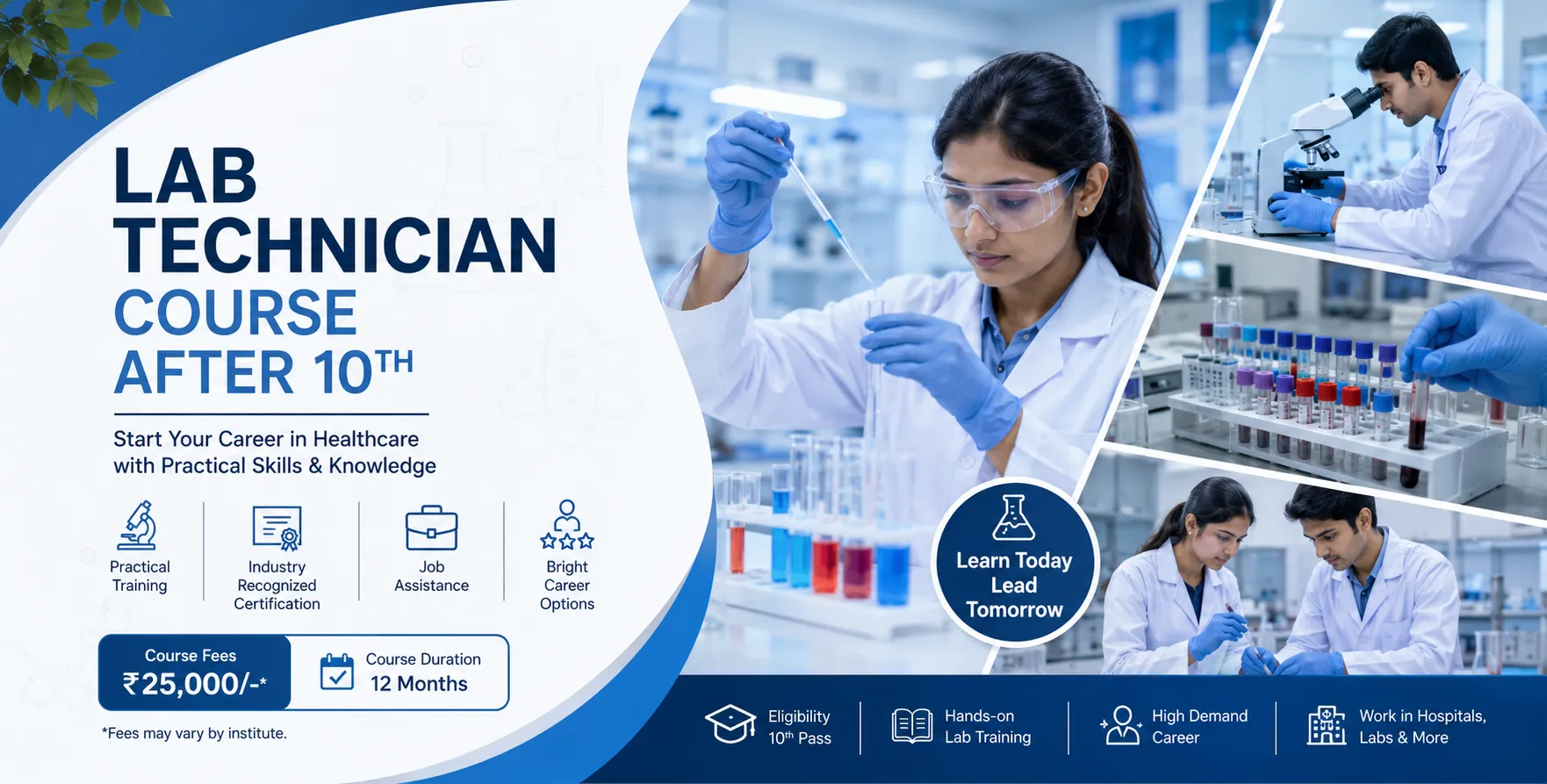
A little over a year ago, I was sitting in my living room with a bunch of college brochures scattered around me, trying to figure out what to do after 10th. My marks were decent, not amazing, and I knew engineering or medicine wasn't really my thing. Someone in my extended family works as a lab technician in a diagnostic centre, and the way she talked about her job, steady income, respected position, always in demand, made me curious. That's how I ended up looking into a lab technician course after 10th.
Now that I've actually finished my first year in a diploma program and worked part-time at a small pathology lab during semester breaks, I want to write the guide I wish I had found back then. Most articles online just list fees and eligibility without telling you what it's actually like or what things really cost once you add up everything.
What Exactly Is a Lab Technician Course After 10th
In simple terms, this is a healthcare course that trains you to work in a medical laboratory, collecting samples, running tests, handling equipment, and helping doctors get accurate reports for diagnosis. You don't need to have taken Science in 10th necessarily, though it does help. Most institutes just ask for a pass in 10th standard, usually with around 50% marks.
There are a few paths students usually pick after 10th:
- Certificate in Medical Laboratory Technology (CMLT), which is short, usually 6 months to a year
- Diploma in Medical Laboratory Technology (DMLT), the most popular option, generally 2 years
- Bachelor of Vocation courses, which combine practical lab training with a proper degree
If you're someone who wants to start working quickly, the certificate route makes sense. But honestly, after talking to seniors and my own lab supervisor, I'd say the diploma gives you a much stronger footing. You can read more about the actual structure in this Diploma in Medical Laboratory Technology after 10th breakdown, it covers the semester-wise subjects better than most brochures do.
Lab Technician Course After 10th Fees
This is the part everyone actually wants to know, so let me be upfront. Fees vary a lot depending on whether you go government or private, and which city you're in. From what I've seen and paid myself, here's a rough idea:
- Certificate courses (CMLT): approximately Rs. 15,000 to Rs. 40,000 for the full course
- Diploma courses (DMLT): approximately Rs. 25,000 to Rs. 90,000 per year, so the full 2 year program can land somewhere around Rs. 50,000 to Rs. 1,80,000 depending on the college
- Government or aided institutes: usually on the lower end, sometimes even under Rs. 25,000 total
- Private colleges with better labs and placement support: can go higher, sometimes crossing a lakh for the full course
I'm giving these as approximate ranges because every college prices things a bit differently, and some bundle in hostel, uniform, and lab kit charges while others charge separately. When I was comparing colleges, two places quoted almost the same "tuition fee" but one had an extra Rs. 10,000 tacked on for lab consumables and exam fees that wasn't obvious from the website. My advice: always ask for a full fee breakup in writing before you pay the admission amount, not just the headline number.
If you're looking at a slightly longer, more structured option, the B.Voc in Medical Laboratory Technology is worth comparing too. It costs a bit more overall since it runs longer, but it gets you an actual degree along with the practical skills, which matters if you ever want to study further or apply abroad later.
Is It Worth the Money
I get asked this a lot by juniors from my school. My honest answer after one year in is yes, but with a condition. It's worth it if you pick a college that actually gives you hands-on lab time and not just theory classes and slides. I've had classmates who joined cheaper colleges and came out barely knowing how to use a centrifuge properly, while others from slightly costlier institutes were confidently running basic blood tests by the end of year one.
So don't just compare the fee number. Ask about lab hours per week, whether they have tie-ups with hospitals for internships, and how recent graduates are doing. A cheaper course that teaches you nothing ends up costing you more time later.
Eligibility and Duration
Eligibility is fairly simple across most colleges:
- Pass in class 10th from a recognised board
- Minimum marks requirement, usually around 45% to 50%, though this varies by institute
- Some colleges prefer a Science background but plenty accept students from any stream
Duration depends on which course you pick:
- Certificate courses: 6 months to 1 year
- Diploma courses: 2 years, split into semesters
- B.Voc programs: 3 years, structured like a degree with skill components
What You Actually Study
I remember being nervous before joining because I had no real Science background beyond school level. Turns out the first semester eases you in with basics of human anatomy, physiology, and lab safety before moving into things like hematology, microbiology, biochemistry, and clinical pathology. By the second year, you're doing actual sample handling, staining techniques, and working with real diagnostic instruments under supervision.
The practical component is honestly where most of the learning happens. Sitting through a chapter on blood grouping is one thing, actually performing it under a lab instructor's watch is a completely different level of understanding.
Career Scope After the Course
This was my biggest question before joining, and now that I've worked part-time in a lab, I can say the demand is real. Diagnostic centres, hospitals, blood banks, and even research labs need trained lab technicians constantly. Starting salaries for freshers are modest, but they climb steadily with experience and specialisation in areas like microbiology or pathology.
A lot of my seniors from the diploma program either joined labs directly or went on to pursue a Bachelor's in Medical Lab Technology for better roles and pay later. The course really works as a foundation rather than a final stop, if you want to keep growing in the field.
If a full lab technician course feels like too big a commitment right now, it's also worth glancing at other paramedical courses after 10th since there are shorter, related options in the same healthcare space that might suit your timeline or budget better.
Choosing a College: A Few Things I Learned the Hard Way
- Don't only compare tuition fees, factor in uniform, lab coat, kit, and exam charges since these add up
- Visit the lab facilities in person if you can, photos on websites can be misleading
- Ask current students how much practical time they actually get, not what the brochure promises
- Check if the college has any placement support or hospital tie-ups, this made a real difference for people in my batch
- If you're checking a medical lab technician course after 10th at a college near you, ask specifically about their affiliated hospital for internships, it matters more than the campus itself
Conclusion
Looking back at my own decision one year ago, I'm glad I didn't just go by the cheapest option or the flashiest website. I spoke to actual students, visited the labs, and asked for a proper fee breakup before choosing. If you're at that same stage right now, take your time with the comparison. The fees matter, but the quality of practical training you get is what actually shapes how confident you'll feel once you're standing in a real lab, holding a sample, and someone's waiting on your result.