
When I started looking for lab technician courses in Delhi last year, I honestly felt overwhelmed. There are institutes in almost every corner of the city claiming to be the best, and everyone's fee structure looks slightly different on paper. I remember sitting with my parents comparing five different brochures on the dining table, none of which actually explained what a typical week in the course looks like.
A year later, I'm through my first year of a diploma program at a Delhi institute, and I've also done a short stint of practical training at a diagnostic lab nearby. So this isn't going to be another list scraped off a directory. This is what I actually went through while choosing, joining, and studying a lab technician course in Delhi.
Why Delhi Makes Sense for This Course
Delhi NCR has one big advantage for anyone doing a medical lab technician course, and that's the sheer number of hospitals, diagnostic chains, and pathology labs around. This matters more than people realise when they're choosing a college. A good chunk of my practical learning didn't happen in the classroom, it happened during internship hours at a lab where I actually had to handle real samples under supervision. Having that many healthcare facilities nearby means more chances for hands-on exposure, which is honestly the part of this course that actually builds your confidence.
If you're weighing your city options at all, it's worth also glancing at paramedical courses in Delhi NCR since the belt around Delhi has quite a few institutes with decent hospital tie-ups, not just the city itself.
Lab Technician Course After 10th in Delhi
A lot of students, like me, don't want to wait till 12th to get started. The good news is several institutes in Delhi accept students right after 10th for certificate and diploma level programs. Eligibility generally asks for a pass in 10th standard, often with around 45% to 50% marks. Some colleges prefer a Science background, but from what I've seen among my batchmates, plenty of institutes accept students from any stream as long as the marks requirement is met.
If you've already completed 12th instead, the entry point and course structure shift a bit, and it's worth checking the specifics rather than assuming it's identical to the after-10th route. There's a helpful breakdown on MLT course details after 12th that explains how the duration and subjects differ depending on when you join.
Lab Technician Course Fees in Delhi
This is usually the first question everyone asks, so let me be direct about it. Fees in Delhi vary quite a bit depending on whether the institute is government-affiliated or private, and how established their lab infrastructure is. Based on what I paid and what I've heard from friends across different colleges, here's a rough picture:
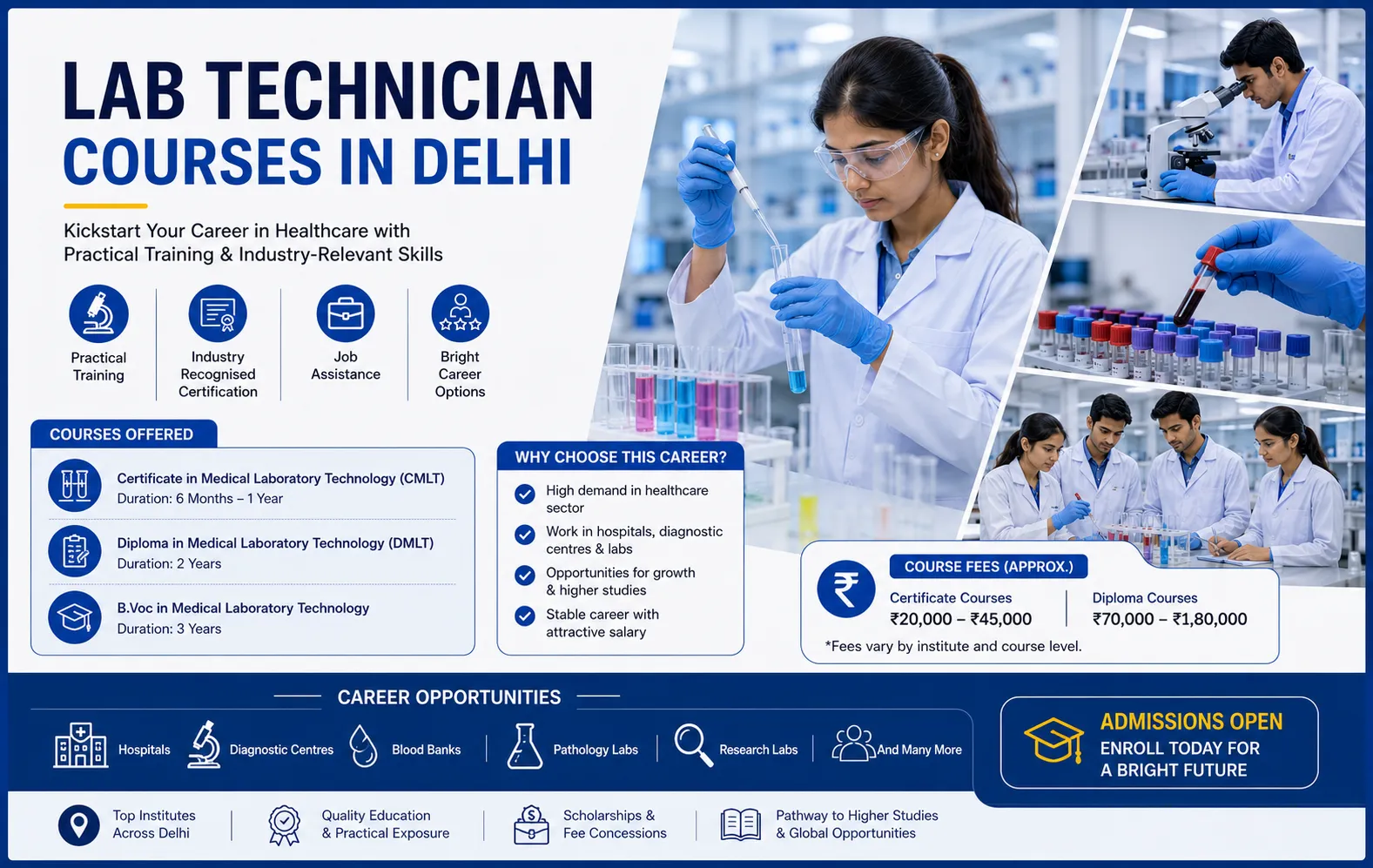
- Certificate courses: approximately Rs. 20,000 to Rs. 45,000 for the full course
- Diploma courses (DMLT): approximately Rs. 35,000 to Rs. 90,000 per year, so the full 2 year diploma can range roughly between Rs. 70,000 and Rs. 1,80,000 depending on the institute
- Government or aided colleges: generally cheaper, sometimes well under Rs. 40,000 for the entire diploma
- Private institutes with better labs and placement tie-ups: tend to be on the higher end, occasionally crossing a lakh or more for the full program
I'm keeping these as approximate ranges on purpose because two colleges I compared quoted almost identical tuition fees, but one of them added separate charges for lab coat, kit, and exam fees that weren't clearly mentioned upfront. My honest suggestion is to ask for the complete fee breakup in writing before paying any admission amount, not just go by the number on the website.
What Actually Happens in Year One
I went in expecting to start testing samples within the first month. That's not really how it works. The early part of the course focuses on building a foundation, basic human anatomy, physiology, and lab safety protocols, before moving into subjects like hematology, microbiology, and biochemistry. It felt slow at first, but once the practical sessions kicked in during the second semester, I understood why that base mattered.
The practical training is genuinely where the course earns its value. Reading about staining techniques in a textbook is one thing, actually preparing a slide yourself and getting corrected by an instructor is a completely different level of learning. By the end of year one, I could handle basic sample collection and simple lab procedures with reasonable confidence, something I definitely couldn't do when I joined.
Choosing the Right Institute in Delhi
Given how many options there are in the city, this part deserves real attention. A few things I wish I'd checked more carefully before choosing:
- How many hours of practical lab work are included each week, not just what's written in the prospectus
- Whether the institute has actual tie-ups with hospitals or diagnostic centres for internships
- Talk to current students directly if you can, admission counsellors tend to paint a rosier picture
- Ask about placement history honestly, including where recent batches actually got placed
- Location and commute matter more than people admit, a long daily commute can genuinely affect how much energy you have left for practical classes
I made the mistake of shortlisting purely on fees in the beginning, and a friend who joined a cheaper institute ended up with barely any practical exposure for the first several months. It worked out for her eventually, but it added unnecessary struggle that could've been avoided with a bit more research upfront.
Career Scope After the Course
This was my biggest worry before starting, whether all this effort would actually lead somewhere. A year in, having spent time at an actual diagnostic lab, I can say the demand for trained lab technicians in Delhi is real and steady. Hospitals, private labs, blood banks, and diagnostic chains are constantly hiring for entry-level and experienced roles alike.
Starting salaries for freshers are modest, which is expected, but they grow with experience and specialisation in areas like microbiology or clinical pathology. Several seniors from my institute have either taken up junior technician roles directly or are planning to pursue further studies for better long-term positions.
Going Beyond the Diploma
A few classmates of mine are already thinking ahead toward advanced qualifications after finishing their diploma. If you want a stronger academic and skill combination, it's worth looking at the B.Voc in Medical Laboratory Technology, which runs longer but gives you an actual degree alongside practical training. And for those who eventually want to move into more specialised or supervisory roles in a lab setting, there's also the M.Voc in Medical Laboratory Technology as a natural next step after a bachelor's level qualification.
I haven't decided my own long-term path yet, but knowing these options exist has taken a lot of pressure off. The diploma doesn't have to be the final stop, it's a solid starting point that keeps doors open.
Conclusion
Looking back at the past year, choosing a lab technician course in Delhi felt overwhelming at the time, but it's become one of the better decisions I've made. The city gives you access to enough hospitals and labs that practical exposure isn't hard to find, as long as you pick an institute that actually prioritises hands-on training over just lectures. If you're at the stage of comparing colleges right now, don't rush the decision purely based on the fee number. Visit a couple of places if you can, ask current students the uncomfortable questions, and get the full fee breakup before you commit to anything.