
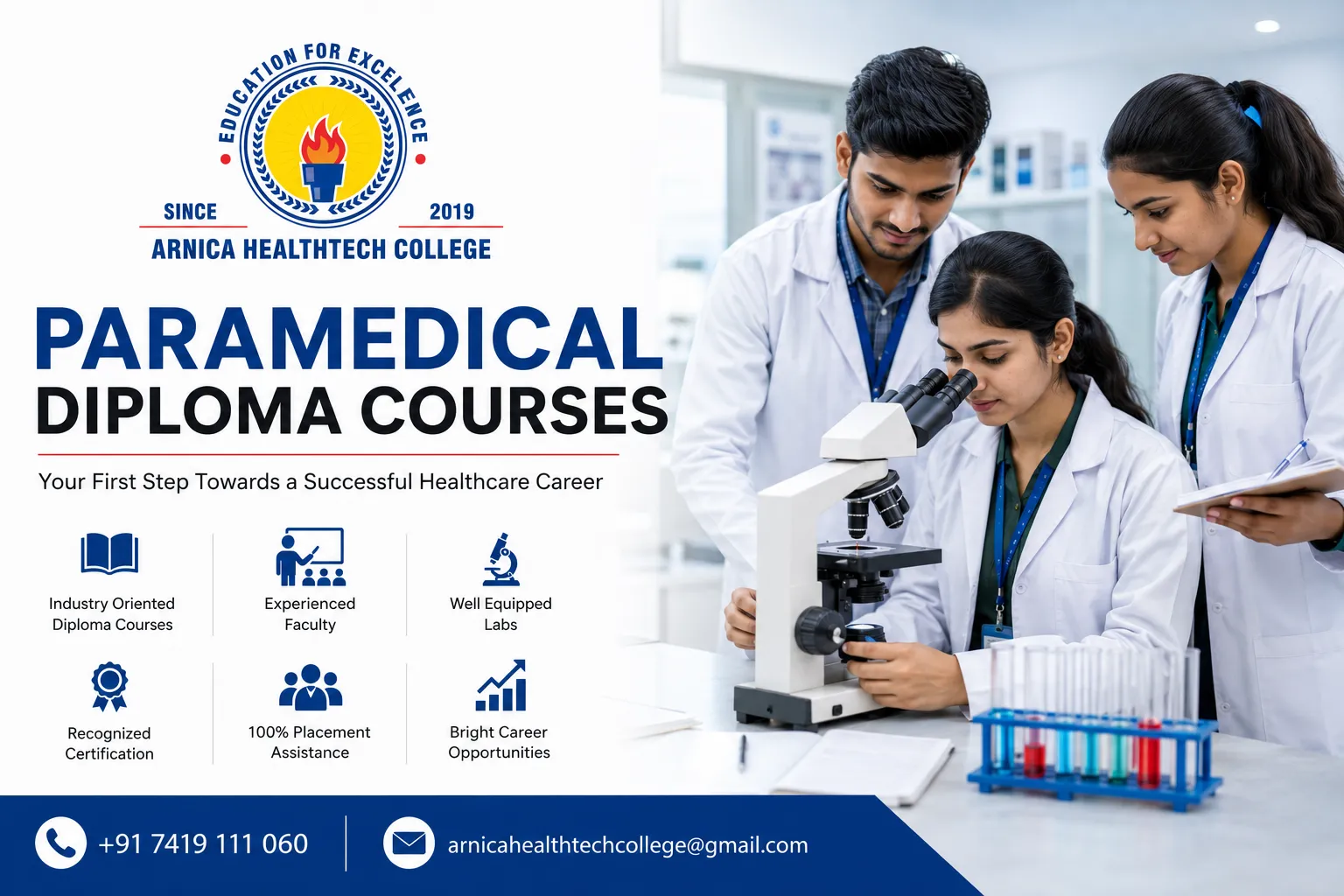
This is the situation students typically find themselves in. They see the term "paramedical diploma courses" and are brought to web pages listing course names, while the key details such as eligibility, course duration, and career options remain absent. This lack of proper information forces families to make decisions about courses and careers, which could be risky.
I have guided numerous students, and I can say that this confusion is usually because no one breaks these things down. Specifically, no one compares the career prospects of a diploma course versus a B.Voc. This guide addresses this problem. By the end of the guide, one should be able to identify the eligibility requirements, duration, specializations, and career options in the various paramedical diploma courses, and select a course best suited to their needs.
What Are Paramedical Diploma Courses?
Quick Answer: Paramedical diploma courses are shorter healthcare courses lasting from one to two years and are designed to place healthcare workers in support roles to doctors and other healthcare specialists to positions such as lab technicians, OT assistants, and radiology assistants.
These courses fit in the gap between secondary education and university education. These courses are much easier to fit into the workforce compared to traditional higher education options, as many ancillary healthcare careers are based in practical skills and less theoretical knowledge.
Some examples of the courses offered by paramedical diploma programs are:
- Medical Laboratory Technology
- Operation Theatre Assistance
- Radiology and Imaging Assistance
- Physiotherapy Assistance
- Dialysis Technology
- Emergency Medical Technology
Did You Know? The shortage of healthcare workers in India isn’t limited to doctors. Workers’ studies mentioned by public health researchers show that India has a considerable shortage of trained healthcare workers to assist doctors and healthcare practitioners, the segment that paramedical diploma programs are designed to serve.
Diploma in Paramedical Courses Eligibility
This is usually the first real question students have, so let us settle it clearly.
| Course Level | Minimum Qualification | Typical Age | Stream Requirement |
|---|---|---|---|
| Diploma after 10th | 10th pass from recognised board | 15 to 17 years | No strict science requirement for some courses |
| Diploma after 12th | 10+2 from recognised board | 17 to 19 years | Physics, Chemistry, Biology preferred |
One mistake I often catch students making is assuming every paramedical diploma requires a science background. That is not always the case. A few diploma in paramedical courses offered right after the 10th standard have eligibility structures that accept students from any stream. They have a few paramedical programs that offered after the 10th, that accept students from any stream, although it would be an advantage to you if you can take science to make the course less difficult from the technical end.
Expert Tip: Don't fall back on old cutoffs you find online if you're not sure if your grades count. Criteria are always changing slightly, so make the call to the institute you are applying to. Don't rule yourself out.
Paramedical Courses After 10th
Many people look up to medical courses after 10th to understand how their children can go through healthcare training even sooner.
At this stage, students select foundational diploma programs that take one or two years and include classroom learning and practical exposure to basic laboratory techniques and patient care. My interactions with students who started healthcare training this way have revealed that time is the greatest advantage. A student who starts a diploma right after 10th can be job-ready by the time their peers are finishing 12th boards.
Here, it is quite common to do a diploma in medical laboratory technology after 10th. This provides exposure to basic skills in laboratory work, sample collection, preparation, and diagnostic support work. This diploma can then be bridged to a full B.Voc degree program if the student wishes to pursue further studies.
Paramedical Courses After 12th
It is noted that students who complete their 12th education are given an added advantage of specializations. This is because most diploma and degree level paramedical courses require individuals to have a 10+2 and the candidate should have completed the school with the science subjects.
While you are still in school and figuring out your options, it would be ideal to look at the entire list of paramedical courses that are available post 12th. This will help you make a better decision, as the eligibility criteria, time commitment, and career options that are available to you after completing medical specializations such as radiology, OT, and medical lab technology can differ extensively.
It is a common misconception that individuals who have completed their 12th education are only able to pursue diploma programs. Individuals who wish to pursue a structured and more advanced qualification, have the choice to pursue a B.Voc degree. The entry to this program is based on stream and scores. This degree offers an advancement over a typical diploma.
Diploma vs B.Voc Degree: What Is the Real Difference?
This comparison comes up constantly, so here is a clear breakdown.
| Factor | Paramedical Diploma | B.Voc Degree |
|---|---|---|
| Duration | 1 to 2 years | 3 years |
| Depth | Foundational, entry-level skills | Advanced, specialised training |
| Career Level | Assistant or technician support roles | Full technologist or technician roles |
| Further Study | Can bridge into degree programs | Can progress to M.Voc postgraduate study |
| Best Suited For | Students wanting quick entry into the workforce | Students wanting long-term career growth and higher roles |
Neither path is wrong. A diploma gets you working faster. A degree gets you further, faster. Your choice depends on whether your priority is immediate income or long-term career ceiling.
List of Popular Paramedical Diploma Specializations
For those still choosing which paramedical diploma course suits you best, this is where students typically begin.
- Diploma in Medical Laboratory Technology, deals with sample testing and technologies supporting diagnostics
- Diploma in Operation Theatre Technology, assistance in operating theatres and sterilisation
- Diploma in Radiology and Imaging Assistance, support with X-rays, CTs and MRIs
- Diploma in Physiotherapy Assistance, support of rehabilitation practice
- Diploma in Dialysis Technology, care of kidneys and operation of dialysis machines
- Diploma in Emergency Medical Technology, support in ambulance and emergency services
If you need to compare every specialisation, their durations and eligibility, the paramedical courses list is the best place to start, before you make your choice.
Career Scope After a Paramedical Diploma
Holding a diploma does not mean your career ends here, in fact, it offers you a substantial starting point.
Common jobs that graduates will find include:
- Lab Assistant or Junior Lab Technician in diagnostic centers
- OT Assistant
- Radiology Assistant
- Physiotherapy Assistant
- Emergency Response Support
From my experience, you will find that diploma holders who receive a hospital internship are hired much more quickly than those without. Students do not realize that practical exposure is more important than the theoretical knowledge learned in the classroom.
Based on the information provided by some of the allied health associations and the industry, diagnostic and rehabilitation services, especially in India, are growing incredibly quickly, and there will be an ongoing need for paramedical support personnel, especially in the tier II and III cities. So, the demand for diploma level paramedical position will be filling rapidly.
Common Mistakes Students Make While Choosing a Diploma Course
- Focusing on course names only, without checking hospital partnerships for hands-on training
- Thinking diplomas have equivalent recognition without checking for accreditations
- Not considering if the program contains a real internship versus a classroom-provided demo
- Forgetting about the opportunity to progress to a full B.Voc degree later on
- Neglecting to compare the various specializations’ career scopes before making a decision
Why Choose AHT College for Paramedical Diploma Courses
Course quality depends heavily on the institute delivering it, and this is where the decision actually gets made.
AHT College, also known as Arnica HealthTech College, builds its paramedical programs around structured hospital and diagnostic centre training rather than treating practical exposure as an afterthought. In my experience, that difference shows up clearly once graduates start job hunting, since employers can tell within the first week which candidates have actually handled real equipment and real patients.
A few reasons students choose AHT College for paramedical training:
- Hands-on training in real diagnostic labs, OT simulation rooms, and imaging suites, not just classroom demonstrations
- A dedicated placement cell with active hospital tie-ups across Delhi NCR
- A clear progression path from diploma level training into full B.Voc and M.Voc degree programs for students who want to advance further
- Small batch sizes that allow direct faculty attention during practical sessions
If you are comparing paramedical courses delhi ncr has to offer, AHT College's approach of pairing foundational diploma level training with a defined path toward full degree programs gives students room to start small and grow their qualification over time, rather than getting stuck at entry level indefinitely.
Conclusion
Students looking to enter the healthcare industry appreciate the opportunity to take an accelerated course, pruning the time it would take to become a full-fledged healthcare professional to be immediately employable. If you are looking to make a decision immediately after the 10th grade or are considering a diploma versus a B.Voc after the 12th grade, the most important thing is to analyze the timetable that is most favorable to you, the area of healthcare that interests you the most, and the degree of in-field instructional training that the college provides.
Stressing the last point is most important when it is virtually impossible to gain employment. The structure of the paramedical program by AHT College creates a framework for real hospital exposure, a framework for placements, and facilitates an educational pathway to a paramedical degree and beyond for those who wish to continue their studies. If you are interested in any of these pathways, have a look at the complete course list of paramedical education offered by AHT College or contact us for personalized assistance with the admission process.