
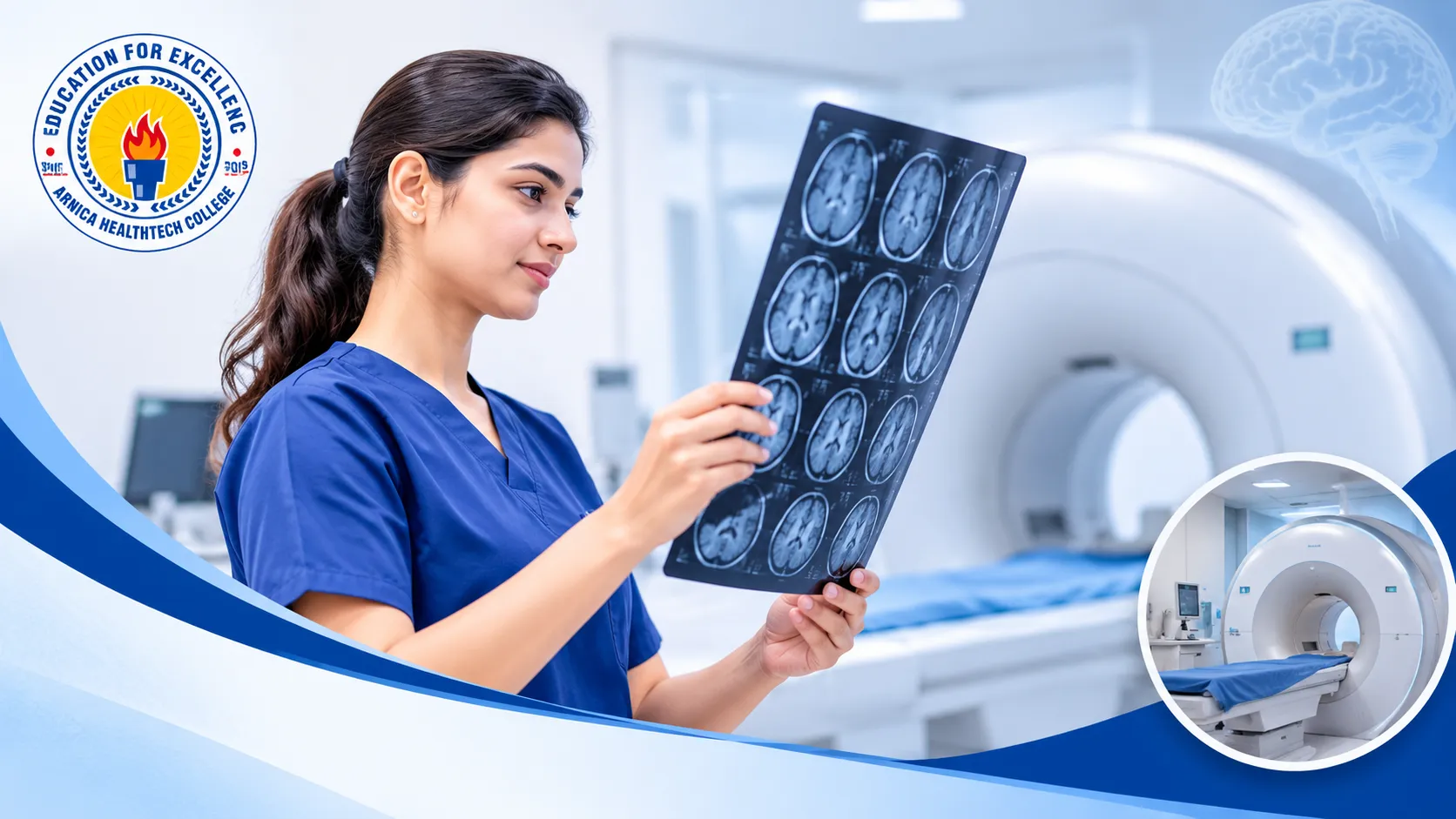
A search for MRI technician course fees returns an odd spread of numbers. Some institutes list 30,000 rupees, others list several lakhs, and almost none explain why. The difference usually comes down to whether the quote covers a short certificate, a full diploma, or a degree, and whether MRI training is a standalone course or part of a wider radiology program.
This guide explains MRI technician course fees in India in plain terms. You will see typical costs by program type, what the total includes, how MRI compares with other imaging courses, and what you can expect to earn afterward. By the end you can judge whether a quoted fee is reasonable for what you are getting.
Need a written fee breakdown?
Call Arnica HealthTech College on 7419111060 and our admission team will walk you through the structure for imaging programs.
What an MRI Technician Does
An MRI technician, also called an MRI technologist, operates magnetic resonance imaging scanners that produce detailed pictures of soft tissue, the brain, the spine, and joints. Unlike X-ray or CT, MRI uses a strong magnetic field and radio waves rather than ionizing radiation, so the safety rules are different and just as strict.
Your day involves screening patients for metal implants, positioning them carefully, explaining the loud scanning noise, and choosing the right imaging sequences for the doctor's request. Patients are often anxious, especially in the narrow bore of the machine, so communication matters as much as technical skill.
Because MRI equipment is among the most expensive in any hospital, training for it tends to cost more than basic X-ray training. That is the first reason fees climb.
MRI Technician Course Fees by Program Level
In India, MRI training is usually delivered inside a broader imaging program or as a short specialization after one. Here are the common routes and their typical fee ranges at private institutes. Exact numbers vary by college.
Certificate in MRI technology
Short certificate programs run from three to twelve months and focus on scanner operation, safety, and basic protocols. Fees commonly fall between 20,000 and 60,000 rupees. These suit students who already hold a radiology diploma or degree and want to add MRI skills.
Diploma in radiology with MRI training
A one to two year diploma that includes MRI modules costs roughly 40,000 to 1,00,000 rupees per year. The full program therefore lands between 1 and 2 lakhs. This is the route most first-time students take, since it builds the foundation of anatomy and imaging physics before specialization.
Degree in radiology and medical imaging technology
A three-year degree such as a B.Voc or BSc covers X-ray, CT, MRI, and ultrasound in depth. Total tuition typically ranges from 2 to 6 lakhs at private colleges. Students who want a recognized degree and long-term growth usually prefer this path. You can read about one such option in our page on the B.Voc radiology and medical imaging technology program.
Postgraduate and advanced training
Master-level programs and advanced MRI certifications cost more, often 1 to 4 lakhs for the program, and prepare you for supervisory, teaching, or application-specialist roles.
What Is Included in MRI Technician Course Fees
Two colleges can quote the same total and deliver very different value. Ask which of these items sit inside the number.
- Tuition and laboratory sessions
- Registration and admission charges
- Semester or annual examination fees
- Clinical posting in a hospital or diagnostic center
- Uniform and study material
- Hostel and mess, where applicable
Clinical posting deserves special attention for MRI. Real scanner time is limited and valuable, so institutes with proper tie-ups pass part of that cost on. A low fee with no scanner exposure leaves a gap that employers notice quickly.
Why MRI Training Costs More Than Basic X-Ray
Several practical reasons explain the higher price tag.
Equipment cost
An MRI scanner costs many times more than an X-ray unit and needs special rooms, shielding, and cooling. Training centers cannot offer unlimited practice on it, so hands-on hours are rationed through hospital partnerships.
Safety and screening training
Magnetic safety is a discipline of its own. Learning to screen for pacemakers, implants, and loose metal takes structured instruction and supervised practice.
Longer learning curve
Choosing sequences, adjusting parameters, and reducing artifacts takes repeated exposure. Programs that build this competence carefully naturally cost more than a quick certificate.
Eligibility for MRI Technician Courses
Entry requirements are similar across most institutes.
- Pass 10+2 with Physics, Chemistry, and Biology or Mathematics for diploma and degree programs
- A radiology diploma or degree for most standalone MRI certificates
- Roughly 40 to 50 percent aggregate marks, depending on the college
- A minimum age of 17 years at admission
NEET is not required for these programs. If you are comparing pathways right after your boards, our guide to the radiology course after 12th shows how diploma and degree routes compare by cost and timeline.
Salary and Career Scope After an MRI Course
MRI skills carry a premium inside the imaging field. A fresher technician usually starts between 2 and 3.5 lakhs per year. With experience and strong sequence knowledge, salaries rise to 5 to 9 lakhs, and senior technologists or application specialists can earn more, especially in large private hospitals and diagnostic chains.
Job options include multi-speciality hospitals, standalone MRI centers, research institutes, and equipment companies that hire application trainers. Demand continues to grow as hospitals add scanners and as doctors rely more on soft tissue imaging. Careers can also extend abroad for qualified candidates. To explore growth paths in more depth, read our overview of the radiology scope in India.
How to Choose the Right Program and Save Money
Paying less is not the goal. Paying a fair price for training that gets you hired is. Use this approach when you shortlist colleges.
- Get the full fee structure in writing before you pay anything.
- Ask which hospital provides scanner access and how many practical hours you get.
- Check the program's affiliation and the recognition of the final certificate.
- Look at placement outcomes for the last two batches, not promotional claims.
- Compare a combined imaging program against separate certificates, because a single integrated course often costs less overall.
Location also matters. Students near the capital region have access to many hospitals for internship, and our page on the radiology course in Delhi explains what to look for locally.
Build Your Imaging Career at Arnica HealthTech College
Arnica HealthTech College in Hodal, Palwal focuses on practical, career-oriented healthcare education. Students interested in imaging can start with the foundation provided by our radiology degree program, then add specialization as their career develops. If you want to see how imaging fits among other fields, the list of paramedical courses in Delhi NCR is a useful starting point.
Our counselors explain every fee component openly, so you can plan your finances with confidence.
Skills You Learn in an MRI Program
Knowing the curriculum helps you see what the fee actually buys. A solid MRI-focused program normally covers the following areas.
- Cross-sectional anatomy of the brain, spine, abdomen, and joints
- Basic MRI physics, including magnetic fields, radio-frequency pulses, and image contrast
- Pulse sequences and how to choose them for a clinical question
- Patient screening, magnetic safety, and handling of implants
- Contrast agents and monitoring for reactions
- Image quality, artifact recognition, and correction
- Patient communication, especially for anxious or claustrophobic patients
The practical component is where most of the value sits. Time at the console, supervised by a senior technologist, teaches judgment that no textbook can. When you compare colleges, ask exactly how many supervised scanning hours each student receives.
Common Mistakes When Comparing MRI Course Fees
Students and parents often make the same few errors, and each one can cost real money.
Choosing only on the lowest price
A very low fee frequently means no scanner access. You may finish the course with a certificate and little confidence, which hurts during interviews and probation.
Ignoring recognition
A certificate from an unrecognized body may not be accepted by hospitals or for higher studies. Verify affiliation before paying the first installment.
Comparing different things
A three-month certificate and a three-year degree cannot be compared on price alone. Match programs of the same level and duration, then compare what each includes.
Skipping the written fee sheet
Verbal quotes change. A written structure protects you if charges appear later.
Payment Options and Financial Support
Most private institutes accept semester-wise payment, which makes a multi-lakh program manageable. Education loans are often available for recognized imaging programs, and some state and skill-development schemes support eligible students. Ask the admission office what is available, and keep your marksheets and identity documents ready so processing is quick.
Quick Cost Summary for MRI Programs
- Certificate add-on for existing radiology graduates: about 20,000 to 60,000 rupees
- Diploma in radiology with MRI modules: about 1 to 2 lakhs in total
- Three-year degree in radiology and imaging: about 2 to 6 lakhs in total
- Advanced or postgraduate MRI training: about 1 to 4 lakhs
Use this summary only as a starting point. The right number for you depends on the college, the clinical posting, and the extras you choose, so always confirm the final figure with the admission office.
Conclusion
MRI technician course fees range widely because MRI training depends on expensive equipment, careful safety instruction, and real clinical exposure. A short certificate costs the least and works best as an add-on, a diploma gives a solid starting point, and a degree builds the strongest long-term profile. Compare what each fee includes, confirm scanner access, and choose the program that prepares you for an actual job.
Ready to take the next step?
Call 7419111060 for a clear fee breakdown and free admission counseling.