
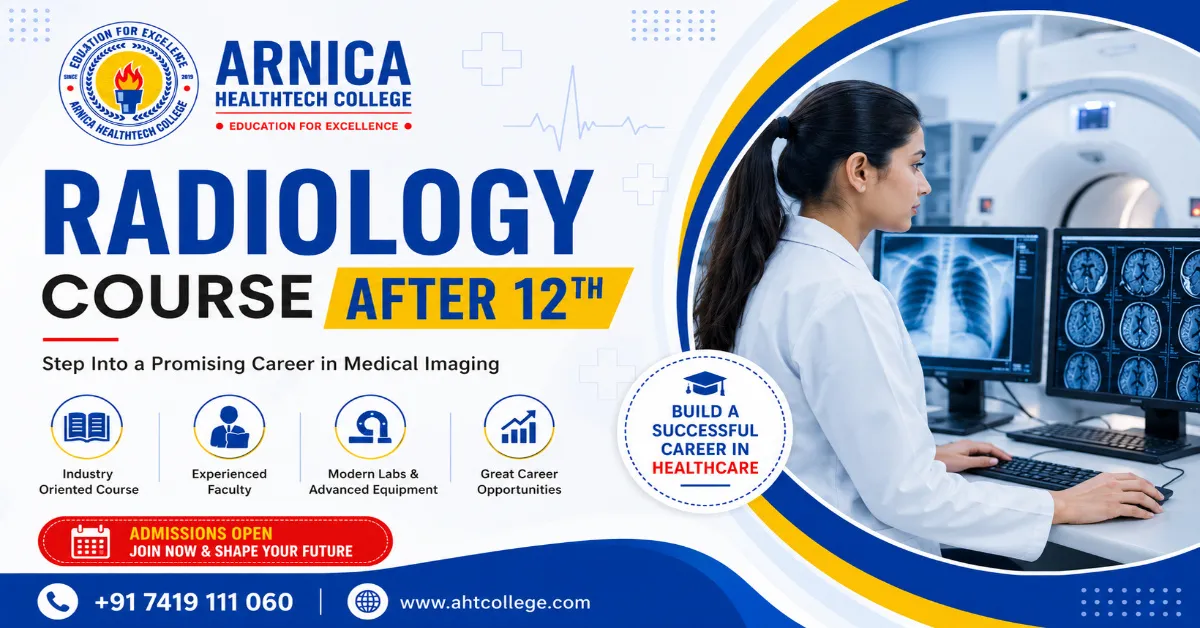
Just finished 12th and considering a radiology course after 12th but not sure where to even begin? You're asking the right question at exactly the right time.
I've spent years observing how students transition from school into paramedical fields, and radiology consistently comes up as one of the smartest, most practical choices for someone who wants a real healthcare career without spending half a decade preparing for entrance exams.
Why a Radiology Course After 12th Makes Sense Right Now
Let's address the obvious question first. Why radiology specifically, and why now?
Every hospital, diagnostic centre and clinic needs trained professionals who can operate imaging equipment correctly. That's not a seasonal need, it's constant. A patient with a fracture needs an X-ray at 2 AM just as much as at 2 PM, and someone trained has to be there.
According to a 2023 healthcare workforce report by the Associated Chambers of Commerce (ASSOCHAM), India's diagnostic imaging sector continues growing at a double-digit rate annually, driven by rising hospital infrastructure across both metro and tier 2 cities. That growth directly translates into job openings for trained radiology professionals.
What Falls Under "Radiology Courses After 12th"
When people search for a radiology course after 12th, they're usually looking at a few different formats, and it genuinely helps to understand the difference before choosing one.
- Short certificate courses: Quick, narrow training focused mainly on basic X-ray operation
- Diploma in radiology after 12th: A mid-length programme covering broader imaging techniques and some clinical exposure
- B.Voc in Radiology: A full, university-affiliated degree combining theory, hands-on lab training and structured hospital internships
- M.Voc in Radiology: A postgraduate specialization, available after completing a B.Voc, for advanced and supervisory roles
In my experience, students often start by Googling the shortest, fastest option, then realize halfway through their research that the depth of training matters far more than the speed of completion.
B.Voc Radiology: Why It's Become the Preferred Path
Among all the formats available, b voc radiology has become the most popular choice for students straight out of 12th, and for good reason.
It's structured as a proper degree programme, not a quick add-on certificate. You get theoretical grounding in anatomy, physics and patient care, combined with hands-on training on real diagnostic equipment like X-ray machines, CT scanners and MRI units.
I've noticed that B.Voc graduates tend to walk into hospital internships with noticeably more confidence than students from shorter certificate tracks. They've had more time with the equipment, more exposure to real clinical scenarios, and a deeper understanding of why each procedure works the way it does.
AHT College structures its B.Voc Radiology programme specifically around this hands-on philosophy, pairing classroom learning with genuine hospital rotation experience rather than treating practical training as an afterthought.
Diploma in Radiology After 12th: A Middle-Ground Option
If a full multi-year degree feels like too long a commitment right now, a diploma in radiology after 12th sits somewhere in between a short certificate and a complete B.Voc programme.
Diploma programmes typically cover core imaging techniques, basic patient handling and foundational radiation safety protocols. They get you into entry-level roles faster than a degree, though usually with less depth and fewer advancement opportunities down the line.
Think of it this way. A certificate teaches you to operate the machine. A diploma teaches you to operate it competently across different scenarios. A B.Voc degree teaches you to understand why you're operating it that way in the first place, and prepares you for growth beyond entry-level work.
Eligibility for a Radiology Course After 12th
The good news here is that eligibility criteria are fairly accessible compared to medical entrance routes.
- Completion of 12th from a recognized board
- Science stream preferred, ideally with Physics, Chemistry and Biology
- Minimum aggregate marks as specified by the individual institute, generally moderate and achievable
This accessibility is part of why so many students view paramedical courses after 12th, especially radiology, as a practical and realistic entry point into healthcare without the years-long preparation that medical school demands.
What You'll Actually Learn During Training
A genuinely solid radiology course after 12th should cover considerably more than just "how to take an X-ray."
Expect coursework and practical training in patient positioning for accurate imaging, safe operation of X-ray, CT and MRI equipment, radiation protection protocols for both patients and staff, basic anatomy and pathology recognition, and digital image processing and documentation.
It's a genuine mix of technical precision and patient care. You're often the person calming down a nervous patient before their scan, and that human element matters just as much as the technical skill.
Radiology Courses After 12th Fees: What Actually Affects the Structure
I'll be upfront about this. Radiology courses after 12th fees vary quite a bit depending on programme length, depth of practical training, and whether hospital internship placement is genuinely built into the curriculum or treated as a separate arrangement.
Rather than chasing whichever option looks cheapest on paper, ask these questions before committing to any institute:
- Does the fee structure include lab access and hands-on equipment training?
- Is hospital internship placement guaranteed as part of the programme?
- Is the qualification affiliated with a recognized university?
- What does the institute's actual placement track record look like?
A radiology course is genuinely an investment in your career trajectory, not just a one-time tuition payment. The right questions reveal far more value than the number on a brochure ever will.
Career Opportunities After Completing Your Radiology Training
This is the part that should genuinely excite you. Once trained, doors open across multiple healthcare environments:
- Government and private hospitals
- Diagnostic and imaging centres
- Trauma and emergency care units
- Oncology and cancer care departments
- Research institutions requiring imaging support
Common roles include Radiology Technician, Imaging Specialist, and with further specialization through M.Voc, Radiology Department Supervisor.
A Quick Reality Check From Experience
I've seen students assume that any paramedical courses after 12th, radiology included, are somehow "easier" than other healthcare careers. They genuinely aren't.
You're handling sensitive diagnostic equipment, following strict radiation safety protocols, and frequently working with anxious or unwell patients. The first few months of hospital exposure can feel intense and demanding.
But that intensity is precisely what builds competent, trusted professionals. Hospitals don't just need someone who understands imaging theory, they need someone who stays calm, precise and reassuring when a real patient is depending on them.
How to Choose the Right Programme for You
Don't choose based on convenience alone. Ask about the actual equipment students train on, how many hours of hospital rotation are built into the curriculum, and what the institute's genuine placement statistics look like, not vague promises.
Final Thoughts
A radiology course after 12th can genuinely set you up for a stable, respected career in one of healthcare's most consistently in-demand fields. Whether you choose a diploma in radiology after 12th for faster entry or commit to a full B.Voc Radiology degree for deeper, long-term career growth, the foundation you build now matters enormously.
AHT College structures its radiology programmes around real hospital exposure and hands-on equipment training, which makes a tangible difference once graduates step into actual clinical environments. Take your time, ask the right questions, and choose a path built on genuine practical training, not just a quick qualification.