
If you are researching CT scan technician course fees, you have probably noticed that the numbers do not line up. A short certificate may cost 25,000 rupees while a full degree that includes CT training runs into several lakhs. Neither figure is wrong. They describe different programs, and the quote rarely tells you which one you are looking at.
This guide explains CT scan technician course fees in India clearly. You will learn what each program level costs, what the fee covers, why CT training is priced higher than basic X-ray, and what the career returns look like. It is written for students who have just finished Class 12 and for parents who want a straight answer before committing money.
Want a written fee structure for imaging programs?
Call Arnica HealthTech College on 7419111060 and our admission team will share the complete breakdown.
What a CT Scan Technician Does
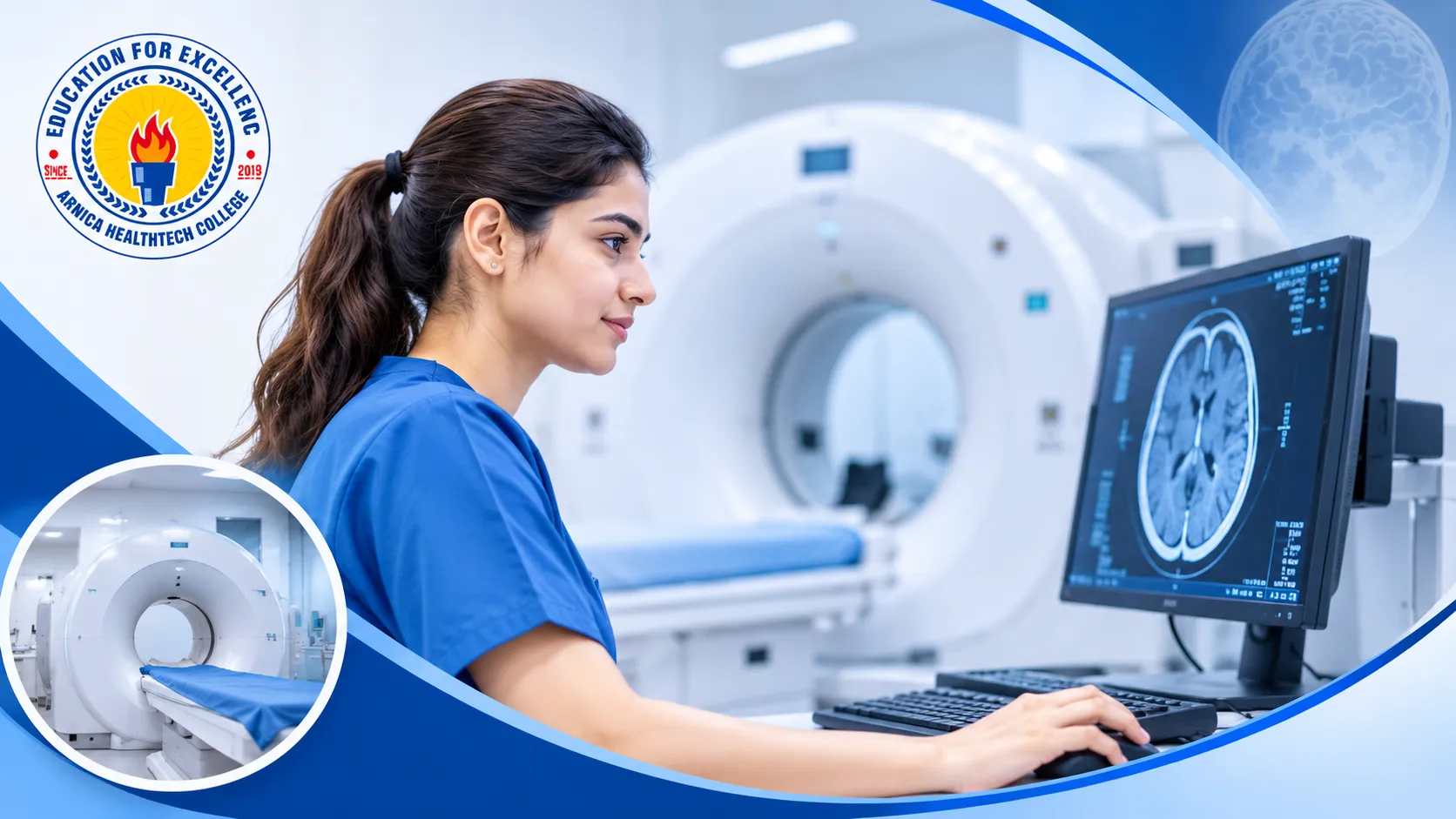
A CT scan technician, also called a CT technologist, operates computed tomography scanners that produce cross-sectional images of the body. Doctors rely on these images to diagnose injuries, tumors, infections, and internal bleeding, often in emergencies where speed and accuracy decide the outcome.
Your responsibilities include verifying the patient's details and allergies, preparing and administering contrast material under medical supervision, positioning the patient, selecting scan protocols, and checking that the images are usable. Radiation dose management is central to the job, because CT delivers a higher dose than a standard X-ray and must be kept as low as reasonably possible.
The combination of emergency pressure, patient care, and technical precision is why CT training takes longer and costs more than entry-level imaging courses.
CT Scan Technician Course Fees by Program Type
CT training is offered as a standalone certificate, as part of a radiology diploma, or inside a degree. Typical ranges at private institutes are given below. Each college sets its own pricing, so use these as a guide.
Certificate in CT scan technology
Certificate programs run from three to twelve months and teach scanner operation, contrast handling, and basic protocols. Fees usually fall between 20,000 and 70,000 rupees. They suit students who already hold a radiology qualification and want to specialize.
Diploma in radiology with CT modules
A one to two year diploma that includes CT training generally costs 40,000 to 1,00,000 rupees per year, or about 1 to 2 lakhs in total. It offers a balanced route into the profession because you learn anatomy and imaging physics first, then move into CT practice.
Degree in radiology and medical imaging technology
Three-year degree programs such as a B.Voc or BSc cover X-ray, CT, MRI, and ultrasound in depth. Total tuition typically sits between 2 and 6 lakhs at private colleges. This path gives you a recognized degree and the widest set of career options. Our page on the B.Voc radiology and medical imaging technology program describes how vocational training and academics combine.
Advanced and postgraduate options
Master-level programs and advanced CT certifications cost more, commonly 1 to 4 lakhs, and lead toward supervisory, teaching, or application-specialist roles.
What Your CT Course Fee Should Cover
Before you compare two colleges, ask what sits inside the quoted number.
- Tuition and laboratory instruction
- Registration and admission charges
- Semester or annual examination fees
- Clinical training in a hospital or diagnostic center
- Radiation safety accessories and uniform
- Study material and library access
- Hostel and mess, if you need accommodation
A flat total that includes everything is easier to plan around than a low tuition figure followed by extra charges. Ask for the structure in writing and keep a copy.
Why CT Training Costs More Than Basic X-Ray
Expensive equipment
A CT scanner is a high-value machine that needs a shielded room and regular maintenance. Training institutes arrange scanner access through hospital partnerships, and that arrangement is reflected in the fee.
Contrast and emergency skills
Handling contrast agents and recognizing adverse reactions requires careful instruction. Emergency scenarios such as trauma and stroke scans demand quick, accurate work, so good programs include supervised practice with real cases.
Dose management
Choosing scan parameters that deliver clear images at the lowest safe dose is a learned skill. It takes repeated exposure, which adds to training time and cost.
Eligibility for CT Scan Technician Courses
Admission rules are consistent across most institutes.
- 10+2 with Physics, Chemistry, and Biology or Mathematics for diploma and degree courses
- A radiology diploma or degree for most standalone CT certificates
- Around 40 to 50 percent aggregate marks, depending on the college
- A minimum age of 17 years at admission
NEET is not required for these programs. Students who are still deciding between routes can compare each option in our guide to the radiology course after 12th.
Salary and Career Scope After a CT Course
CT skills are in steady demand, and the pay reflects that. A fresher CT technician usually earns between 2 and 3.5 lakhs per year. After a few years of experience, salaries commonly reach 4 to 8 lakhs, and senior technologists in large hospitals or diagnostic chains can earn more.
Opportunities exist in government hospitals, private multi-speciality hospitals, trauma centers, and independent diagnostic labs. Many technicians later add MRI skills, which widens options further. For a fuller picture of specializations and long-term growth, read our overview of the radiology scope in India.
How to Choose a CT Program and Control Costs
- Request the full fee structure in writing before paying.
- Ask where scanner training takes place and how many practical hours you will get.
- Verify the affiliation and recognition of the certificate.
- Check placement outcomes for the last two batches.
- Consider an integrated imaging program, which can cost less than collecting separate certificates later.
Location is another factor. The capital region has a large number of hospitals that offer internship opportunities, and our page on the radiology course in Delhi explains what to expect there.
Train for Imaging Careers at Arnica HealthTech College
Arnica HealthTech College in Hodal, Palwal provides career-oriented healthcare education built around practical training. Students who want to enter imaging can begin with our radiology degree path and specialize in CT as they grow. If you would like to see how radiology compares with other fields, the guide to paramedical courses in Delhi NCR is a good place to start.
Our counselors explain each fee component openly, so you can plan with confidence.
Skills You Learn in a CT Program
The curriculum shows what your fee is really paying for. A strong CT-focused program usually covers these areas.
- Cross-sectional anatomy of the head, chest, abdomen, and extremities
- CT physics, including detectors, slice thickness, and reconstruction
- Scan protocols for trauma, stroke, cardiac, and abdominal studies
- Contrast preparation, injection techniques, and reaction management
- Radiation dose optimization and safety culture
- Image post-processing and quality checks
- Patient care, communication, and emergency response
Supervised hands-on scanning is the most valuable part of any CT course. Ask how many hours each student spends on a live scanner, and whether training includes emergency and trauma cases, since those teach speed and accuracy together.
Common Mistakes When Comparing CT Course Fees
Choosing the cheapest option
A low price often means no scanner access. A certificate without real practice does little for your first interview.
Overlooking recognition
Hospitals and universities may not accept a certificate from an unrecognized body. Verify affiliation before you pay.
Comparing unlike programs
A short certificate and a degree are not equivalent. Compare programs of the same level, then look at what each fee includes.
Relying on verbal quotes
Charges that were never written down tend to grow. Insist on a written fee sheet and keep a copy.
Payment Plans and Financial Support
Many private institutes accept semester-wise or installment payments, which makes a larger program easier to manage. Education loans are commonly available for recognized imaging programs, and some state and skill-development schemes help eligible students. Ask the admission office about available support, and prepare marksheets and identity documents in advance so processing moves quickly.
CT Scan Technician or MRI Technician: Which Should You Choose?
Both roles sit in the same field and pay similarly. CT work is faster and more emergency-driven, with a strong focus on radiation dose. MRI work is slower and more detail-oriented, with a focus on magnetic safety and sequence selection. Many professionals learn both over time. If you are unsure, start with a broad radiology program and specialize once you have seen each environment during your clinical posting.
Quick Cost Summary for CT Programs
- Certificate add-on for existing radiology graduates: about 20,000 to 70,000 rupees
- Diploma in radiology with CT modules: about 1 to 2 lakhs in total
- Three-year degree in radiology and imaging: about 2 to 6 lakhs in total
- Advanced or postgraduate CT training: about 1 to 4 lakhs
Treat these numbers as a starting point only. Your final cost depends on the college, the length of clinical posting, and any extras such as hostel, so confirm the figure with the admission office before you decide.
It also helps to speak with a working technician if you can. Ask what they wish they had learned in college, and which parts of their training proved most useful on the job. Their answers often reveal which program features are worth paying for.
Conclusion
CT scan technician course fees vary because CT training relies on costly equipment, contrast and dose management skills, and real clinical exposure. A certificate is the cheapest option and works best for those who already hold a radiology qualification. A diploma balances cost and depth, and a degree gives the strongest foundation for a long career. Compare what each fee includes, confirm scanner access, and pick the program that prepares you for real work.
Ready to plan your admission?
Call 7419111060 for a clear fee breakdown and free counseling.