
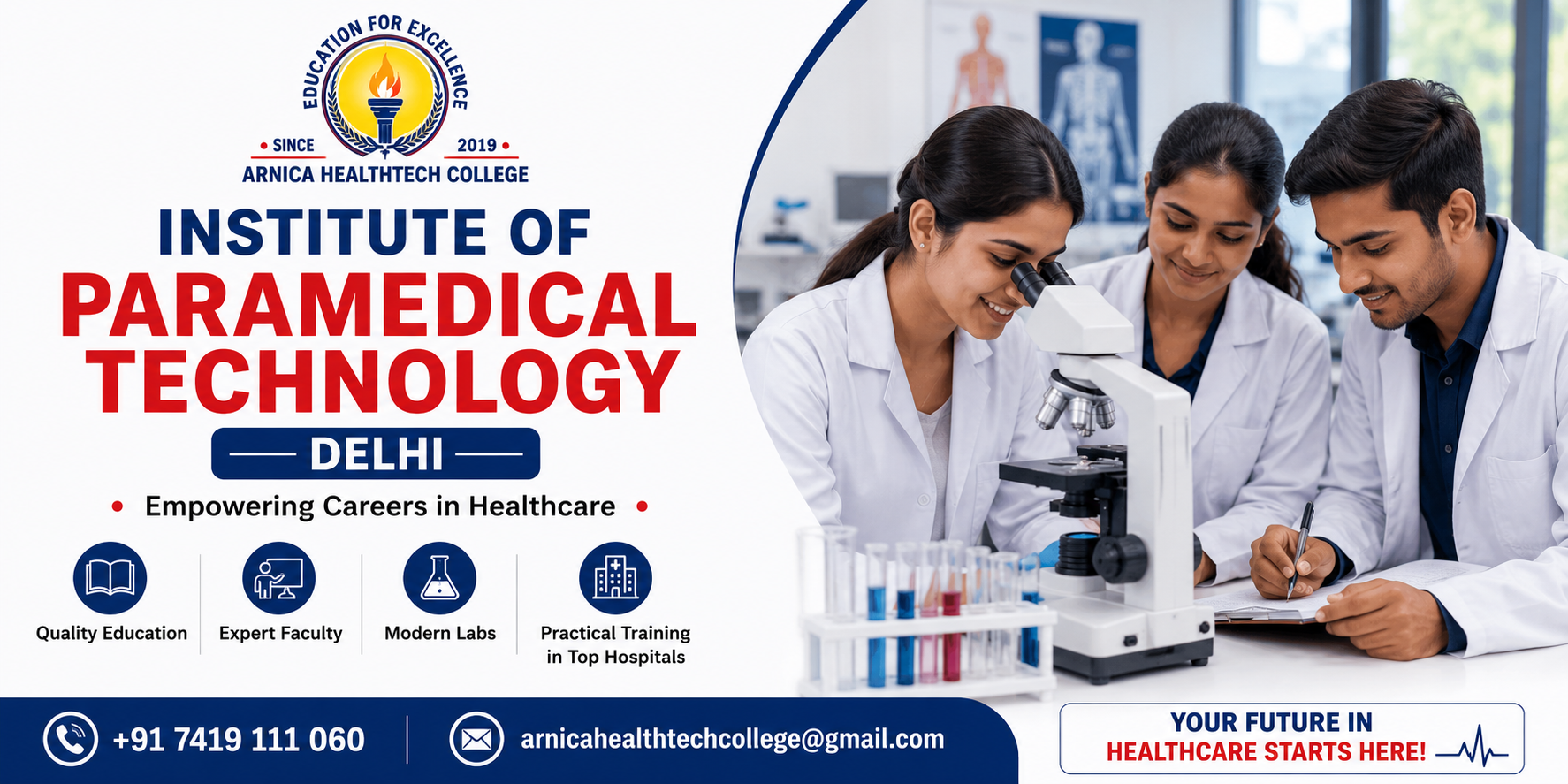
If you're searching for an institute of paramedical technology in Delhi, you're likely a 12th-pass student or a parent trying to figure out which course actually leads somewhere, and which institute is worth trusting with three years of your time. That decision matters more than most people realise, because paramedical education varies wildly in quality between institutes, even when the course names look identical on paper.
This guide breaks down what a genuine paramedical technology institute should offer, how to evaluate one properly, and what the major course options actually involve.
What Is Paramedical Technology and Why It Matters
Paramedical technology covers the technical, hands-on side of healthcare delivery. It's the course of paramedical study that trains professionals to support doctors directly, in labs, operation theatres, radiology departments, and physiotherapy units.
Quick Answer: Paramedical technology courses train students in specific clinical skills such as lab diagnostics, OT assistance, medical imaging, or rehabilitation therapy, typically through a 3-year B.Voc degree after 12th, preparing them for direct employment in hospitals and diagnostic centres.
Unlike a medical degree, a paramedical course is shorter, more skill-focused, and gets you job-ready faster. That's precisely why demand for a reliable institute of paramedical in Delhi and the wider NCR region keeps climbing every year.
Why Delhi NCR Specifically
Delhi NCR has one of the highest concentrations of hospitals, diagnostic chains, and multi-speciality centres in North India. That density creates consistent hiring demand for paramedical technicians, which is exactly why so many students search for a delhi institute of paramedical science rather than settling for whatever's available in their hometown.
Best Paramedical Courses After 12th
Not every paramedical course leads to the same career, and the best paramedical courses for one student might be the wrong fit for another. Here's a breakdown of the major options.
| Course | Duration | Focus Area | Typical Role |
|---|---|---|---|
| B.Voc Medical Lab Technology | 3 years | Diagnostics, sample testing | Lab Technician |
| B.Voc Radiology & Medical Imaging | 3 years | X-ray, CT, MRI operation | Radiology Technician |
| B.Voc Operation Theatre Technology | 3 years | Surgical assistance | OT Technician |
| B.Voc Physiotherapy | 3 years | Rehabilitation therapy | Physiotherapy Assistant |
| M.Voc (any specialisation) | 2 years | Advanced, supervisory skills | Senior Technician / Supervisor |
OTT Paramedical Course: A Closer Look
The ott paramedical course, more formally the paramedical operation theatre course, trains students to assist surgeons directly inside the OT. That means sterilisation protocols, instrument handling, patient positioning, and coordinating with the surgical team under pressure.
In my experience, this is one of the more demanding paramedical tracks, simply because there's no room for error once a procedure begins. Students who do well here tend to be calm under pressure and genuinely detail-oriented, not just academically strong.
Eligibility for Paramedical Courses
Most B.Voc paramedical programs, including medical lab technology, radiology, and OT technology, require:
- 12th pass, generally with Physics, Chemistry, and Biology (PCB)
- Minimum aggregate marks as set by the individual institute
- Some institutes offer bridging modules for arts or commerce students, though this varies significantly
Important Note: Never assume every institute of paramedical technology accepts non-science students. Verify directly with the admissions office, since eligibility rules differ between colleges even for the same course name.
What Actually Separates a Good Institute From an Average One
This is where most comparison articles fall short. Course names look the same everywhere. What differs is execution.
From working with students who've gone through different paramedical programs, here's what genuinely separates strong institutes from weak ones:
- Real hands-on lab and clinical exposure, not just lecture-based theory
- Hospital and diagnostic centre tie-ups for practical training and internships
- Placement support that's documented, not just promised verbally
- Faculty with clinical, not purely academic, backgrounds
- Recognised vocational degree status (UGC-aligned B.Voc/M.Voc), not an unregulated short-term certificate
Common Mistake: Many students choose an institute of paramedical purely based on brochure claims or proximity to home, without checking whether the practical training component is substantial. This is the single biggest regret I hear from graduates a year into their job search.
Checklist Before You Finalise an Institute
Use this quick checklist when comparing any institute of paramedical technology in Delhi:
- Is the degree recognised (B.Voc/M.Voc under a UGC-aligned framework)?
- Does the curriculum include structured lab or clinical hours, not just classroom sessions?
- Are there active hospital or diagnostic partnerships?
- Is placement assistance documented, with named partner organisations?
- Are faculty members practicing or formerly practicing clinical professionals?
Career Scope After a Paramedical Course
Many people are surprised when they learn how broad the employment base is for paramedical graduates. It isn't limited to large hospitals.
Common career paths include:
- Lab technician in hospitals, diagnostic chains, and pathology labs
- Radiology technician operating imaging equipment
- Operation theatre technician assisting surgical teams
- Physiotherapy assistant in rehabilitation and sports medicine settings
- Blood bank and research lab roles
Did You Know? According to WHO's guidance on the global health workforce, allied health professionals, including paramedical technicians, form a critical part of closing healthcare delivery gaps, particularly as diagnostic and treatment infrastructure expands into smaller cities.
Diagnostics and outpatient care are among the fastest-growing segments of Indian healthcare, and that growth depends directly on trained paramedical staff, not just doctors. That's the practical reason demand for a solid institute of paramedical technology continues rising across Delhi NCR.
B.Voc vs Short-Term Certificate: Don't Confuse the Two
One mistake I often see is students conflating a proper B.Voc paramedical degree with a 6-month or 1-year private certificate course.
| Factor | B.Voc Degree | Short-Term Certificate |
|---|---|---|
| Duration | 3 years | 3-12 months |
| Recognition | UGC-aligned vocational degree | Often unregulated |
| Depth of Training | Comprehensive, multi-semester | Surface-level |
| Career Ceiling | Technician to supervisor roles | Entry-level only, limited growth |
| Further Study | Can progress to M.Voc | Rarely creates a clear progression path |
A short certificate might look faster, but it typically limits how far you can grow within a hospital or diagnostic setting. If you're serious about a long-term paramedical career, a recognised degree is almost always the better investment of your time.
How to Shortlist the Right Institute
Before you commit to any institute of paramedical technology in Delhi NCR, take these steps:
- Visit the campus or lab facilities in person if possible
- Ask current students about their actual practical training hours
- Request specifics on placement partners, not just a general claim of "100% placement"
- Confirm the exact course structure semester by semester
- Compare fee structure against what's actually included, including uniforms, lab kits, and internships
If you'd like a closer look at how a structured paramedical program is built, AHT College's course pages break down the semester-wise curriculum and practical training component for each specialisation, which is worth reviewing before you shortlist your final options.
Conclusion
Picking the right institute of paramedical technology in Delhi isn't about finding the college with the flashiest brochure. It comes down to verifying real practical exposure, recognised degree status, and genuine placement support, the things that actually determine whether you're job-ready three years from now. Whether you're drawn to lab diagnostics, the ott paramedical course, radiology, or physiotherapy, take the time to compare institutes properly before enrolling. If you want to explore how a Delhi NCR-based paramedical program structures its training and placement support, reach out to AHT College's admissions team for a detailed breakdown of course options.
Key Takeaways
- Paramedical technology courses are shorter and more skill-focused than a full medical degree
- B.Voc programs typically run 3 years; M.Voc programs run 2 years for those with a prior diploma
- Eligibility usually requires 12th with PCB, though some institutes offer bridging paths for arts/commerce
- Real hands-on training and hospital tie-ups matter more than brochure claims
- Career scope spans lab diagnostics, radiology, OT assistance, and physiotherapy
- Always verify recognition status and placement support before enrolling