
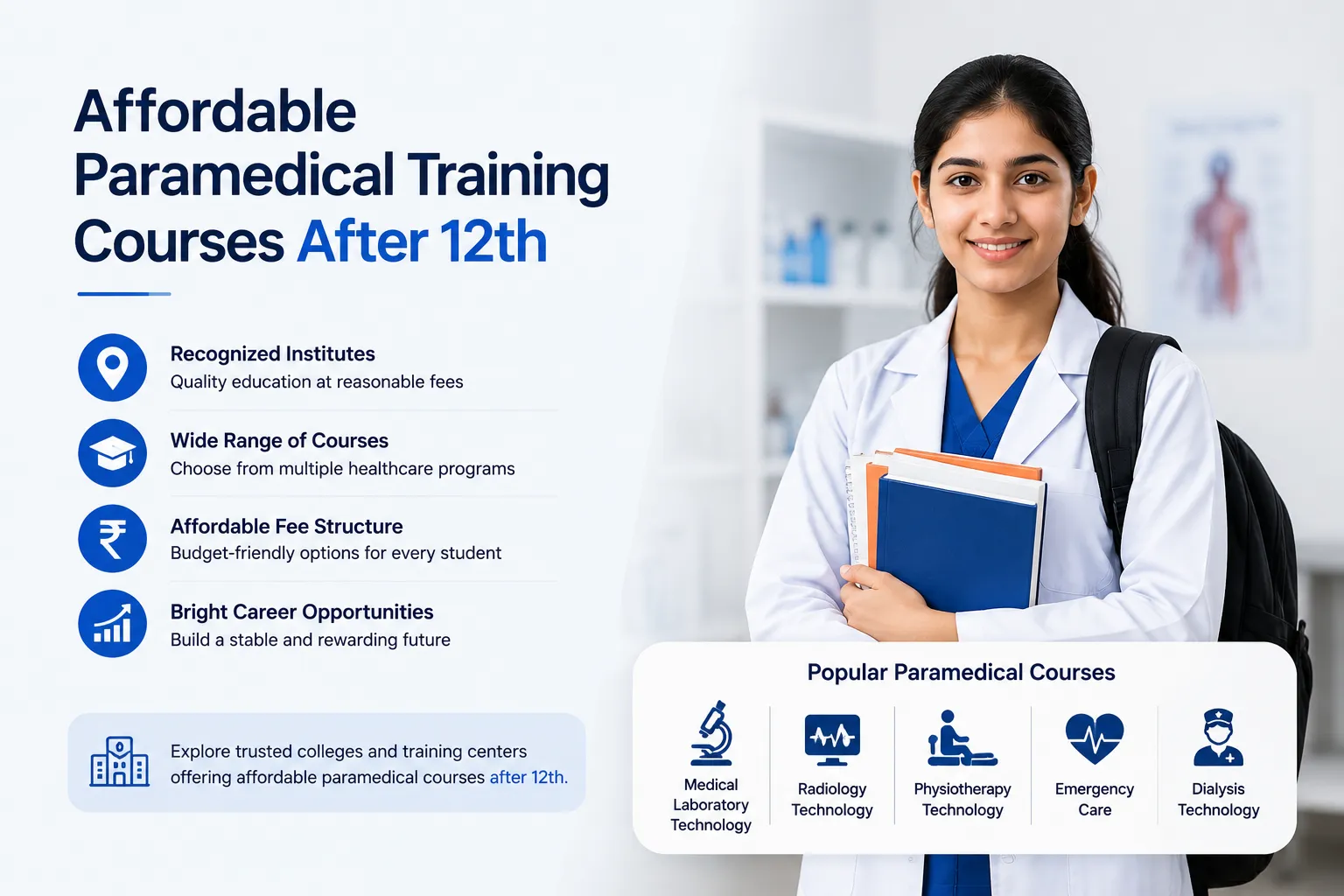
This question came up in almost every conversation I had with juniors last year when I was deciding what to do after 12th. Everyone wanted to get into healthcare in some form, lab technology, radiology, nursing assistance, but the moment fees came up, half the group would just drop the idea entirely, assuming paramedical courses are always expensive private-college affairs.
I went through that exact search myself, comparing colleges, calling admission offices, and sitting through a few disappointing counselling sessions where the "affordable" course turned out to have hidden charges once you actually read the fine print. So here's what I actually learned about finding genuinely affordable paramedical training after 12th, based on real comparisons and not just what the brochures promise.
First, Understand What "Affordable" Actually Means Here
Before jumping into where to look, it helps to know what range you're even comparing against. Paramedical courses in India, whether it's lab technology, radiology, or nursing assistant programs, generally fall into a wide fee bracket depending on the institute type. Government and aided colleges tend to sit on the lower end, while private institutes can range from moderately priced to fairly expensive depending on their infrastructure and placement support.
The mistake I made early on was comparing colleges purely by the number on their website without checking what's actually included. Some quote just the tuition fee and add lab kit, uniform, and exam charges separately later, which quietly pushes the real cost up. So "affordable" should really mean the full cost, not just the headline figure.
Government and Aided Paramedical Institutes
This is genuinely the first place to look if budget is your main concern. Government-run polytechnics and paramedical colleges usually charge significantly less than private institutes for similar diploma programs in lab technology, radiology, or other allied health fields. The catch is that seats are limited and admission is often merit-based or through entrance exams, so competition can be tough.
I applied to a couple of government-aided options myself and didn't get through on the first attempt, mostly because I didn't prepare early enough for their entrance process. If you're serious about this route, start checking application timelines well before your 12th results come out, since many of these colleges have narrow admission windows.
State-Run Skill Development and ITI Programs
A lot of students overlook this option entirely. Several state skill development boards and ITIs (Industrial Training Institutes) run shorter paramedical or allied health certificate programs at a fraction of private college costs. These aren't always as comprehensive as a full diploma, but for someone wanting to enter the workforce quickly on a tight budget, they're worth exploring.
A cousin of mine went through one of these programs for a lab assistant certification and ended up working within a few months of completing it. It's not the flashiest route, but it genuinely works if affordability and speed matter more than a longer academic structure.
Private Colleges With Scholarship or Fee Concession Options
Not every private institute is out of reach financially. A good number of them offer merit-based scholarships, fee concessions for economically weaker sections, or installment-based payment plans that make the course manageable even if the sticker price looks high at first glance. When I was comparing options, one private college I almost ruled out due to fees turned out to have a scholarship scheme that brought the actual cost down close to what a mid-range government college was charging.
The trick is you usually have to ask directly, this information isn't always front and centre on their website. When you're shortlisting colleges, specifically ask the admission office about scholarships, concessions for certain categories, and whether they allow fee payment in installments rather than one lump sum.
Comparing Course Types, Not Just Colleges
Something I didn't consider initially is that the course type itself affects affordability just as much as the institute. A short certificate course will naturally cost less than a full diploma, and a diploma will cost less than a bachelor's degree, simply because of duration and depth. If your priority is affordability and getting into the workforce quickly, a certificate or diploma level paramedical course might make more financial sense than jumping straight into a longer degree program, at least to begin with.
You can always build on a shorter course later once you're earning and have a clearer sense of which specialisation actually interests you. That's the path a few of my batchmates took, starting with a diploma, working for a year or two, and then pursuing further studies once they had some savings and clarity.
Region Matters More Than People Expect
Where you choose to study genuinely affects your total cost, not just tuition but also commuting, hostel, and daily living expenses. If you're based in or near a metro region, it's worth comparing local options carefully rather than assuming you need to relocate somewhere expensive for a "better" college. There are quite a few institutes clustered around Paramedical Courses Delhi NCR with a decent mix of fee ranges, and staying local can save a meaningful amount that would otherwise go toward hostel or PG accommodation.
Actually Comparing Course Options Properly
Once you've narrowed down a region and a rough budget, the next step is comparing what different paramedical fields actually offer for that cost. Lab technology, radiology, nursing assistance, and dialysis technology courses all differ in duration, practical training intensity, and career outcomes, so it's worth looking at a proper side-by-side rather than picking based on which brochure looked nicer. There's a solid comparison of options in this guide to the Best Paramedical Courses After 12th that helped me understand which fields actually matched my interest and budget before I made my final decision.
Questions I'd Recommend Asking Before You Commit
Based on the mistakes I nearly made and the ones a few friends actually did make, here's what I'd tell anyone searching for an affordable paramedical course right now:
- Ask for the complete fee breakup in writing, including lab kit, uniform, and exam charges, not just tuition
- Check if scholarships or installment plans are available, even at colleges that initially look expensive
- Compare government, aided, and private options in your region before assuming private is your only choice
- Confirm how many hours of practical training are included, since a cheaper course with almost no hands-on exposure isn't actually a good deal
- Ask about placement support and hospital tie-ups, since a low-cost course that doesn't lead anywhere isn't really saving you money in the long run
A Realistic Way to Approach the Search
If I were starting this search again from scratch, I'd do it in this order. First, check nearby government and aided institutes and their admission timelines. Second, shortlist a few private colleges in your region and specifically ask about scholarships and fee concessions rather than assuming the listed price is final. Third, compare the actual course type you're leaning toward, since a shorter certificate or diploma can be a genuinely affordable entry point even at a private institute. And finally, don't finalise anything without confirming practical training hours and placement support, because the real value of any paramedical course comes from how job-ready it actually makes you.
The College I Actually Chose: AHT College
I'll be upfront about this, since it's relevant to everything I've written above. AHT College is where I ended up enrolling myself, and it's a big part of why I could write this piece with actual experience instead of just secondhand research. What pulled me toward it in the first place was the fee structure, it was noticeably more reasonable than several private institutes I'd shortlisted, without feeling like a stripped-down, bare-minimum program.
The thing that's mattered most to me a year in is the practical training. Classes aren't just lecture after lecture, there's real lab time built into the schedule every week, which, as I mentioned earlier, is exactly what separates a course that's actually worth its cost from one that just looks good on paper. Between the lab technology and radiology programs they offer, along with a few other allied health courses, I found it easy to compare options within one place instead of running between different colleges for each field.
If you're comparing institutes in the Delhi NCR region and affordability is a real factor for you, AHT College is worth putting on your shortlist. I'd still say the same thing I've said about every other college in this piece, ask for the full fee breakup, check on scholarship options if you're eligible, and confirm the practical training hours before you commit. That's exactly what I did before joining, and it's part of why the decision has held up well for me so far.
Conclusion
Affordable paramedical training after 12th does exist, it just takes a bit more digging than picking the first college that shows up in a search. Government and aided institutes, skill development programs, and private colleges with scholarship schemes are all realistic paths depending on your situation. Take the time to compare properly, ask direct questions about the full cost, and don't assume the cheapest listed fee is automatically the best deal, or that the most expensive one is automatically the better course. The right fit is usually somewhere in between, once you've actually done the comparison yourself.